Oil Rich Gulf States and Emigration in Pakistan
- Bon Habler
- Jan 30, 2025
- 4 min read

Population Trend of Oil Rich "Small" States
I am still analyzing the world population and migrant data because it indicates many uncovered aspects of each country and the whole world. In any case, I noticed that "small" oil rich gulf states are very new countries where most of the citizens came to the place after 1960. (*When I say "small" oil rich countries, I exclude Saudi Arabia.) In this article, I focus on UAE, Qatar and Kuwait because the three countries play a big role in the Gulf War and recent war in the middle east.
Yesterday, I explained how the population trends in UAE and Qatar are unusual. The following graph explains the net migration (immigration minus emigration) dynamics in Qatar and UAE (1960 - 2020). As I wrote yesterday, both countries have two significant peaks of immigrants in 2003 (Iraqi War) and 2014 (War against ISIS - CENTCOM's CJTF-OIR).

Next graphs are about population and cumulative sum of migrants in Qatar and UAE. Cumulative sum is the sum of the coming immigrants and left emigrants in each year. So, it roughly estimates the numbers of immigrant origin populations.
You can easily find that both countries had almost no population around 1960 and their population numbers increased by accordance with the cumulative sum of immigrants. It means that majority of the population of the two countries are immigrants and their descendants (descendants are often counted as local populations if they were born in the country). Perhaps, the CENTCOM immigrants in 2003 and 2014 made children in such countries because the CENTCOM missions and population growth have a strong correlation as I mentioned in the last post.
Also, I add a graph about the population and cumulative sum of migration in Egypt as an example of a normal and old country. You can compare how the population dynamics in the small gulf states are very unusual.


And another example is in Kuwait. In August of 1990, Hussein Iraq invaded Kuwait and many people left the country. This could be why the government even could not submit population data for a few years after 1990. the However, such diaspora gradually came back to Kuwait after the US led Iraqi war.
It also shows that Hussein Iraq mainly attacked the immigrants in Kuwait because migrant number saw a sharp decline.

Iran-Iraq War and the First Gulf War
As an additional information, it seems that the Iran- Iraq war (1980 - 1988) might be led by Kuwait faction. At that time, Kuwait made a large financial support (often "tied" aid). Tied aid refers to aid that must use goods and services from the donor country, and it often uses as a way of invasion by the donor country but pushed responsibility to the recipient country.
So, perhaps, after Hussein noticed this trap by Kuwait, he decided to "invade" Kuwait (or the aid trap faction in Kuwait, possibly foreign immigrants in Kuwait).
For me, it was a bit mysterious that Hussein fought against "Iran" after the Iranian Revolution in 1979. In the revolution, Islamic republic faction ousted the Pahlavi monarchists (synonym of the British colonists) in Iran. Also, in the Iran-Iraq war in the 1980s, Iran was attacked by F-15 and F-16 (manufactured by Mitsubishi). So, someone in Iraq cooperated with Mitsubishi and the Japanese empire. However, in the first Gulf war (originated in the Iraqi invasion of Kuwait), it was also F-15 and F-16 which attacked Hussein Iraq.
But if the 1980s Iran-Iraqi war was mainly caused by Kuwait (against Iran) and Hussein tried to oust such Kuwait faction in the first Gulf war, it makes sense. Kuwait is also a monarchy country, therefore, it is likely that Kuwait tied aid trap faction cooperated with Pahlavi faction in Iran. Perhaps, they tried to cause a reconquista coup against the Iran Islam Republic.
Emigration from Pakistan
Osama Bin Laden tried to fight in the first Gulf war against Iraq on the side of Kuwait/ CENTCOM. However, it was rejected by the Saudi government. He spent several years in Sudan to construct infrastructure there. And then, he moved to Pakistan in the end. Also, many terrorists in the middle east have Pakistani origin surname. It is likely that Pakistan has been a major human resource hub of terrorists.
Here is the chart of Pakistan. Except around 1980, Pakistan has been a country of emigration where lots of people leave the country. There is a big emigration peak around 2016. So, maybe the country supplied the major soldiers to kill ISIL/ Hussein faction in Iraq and the middle East since the ISIS war.
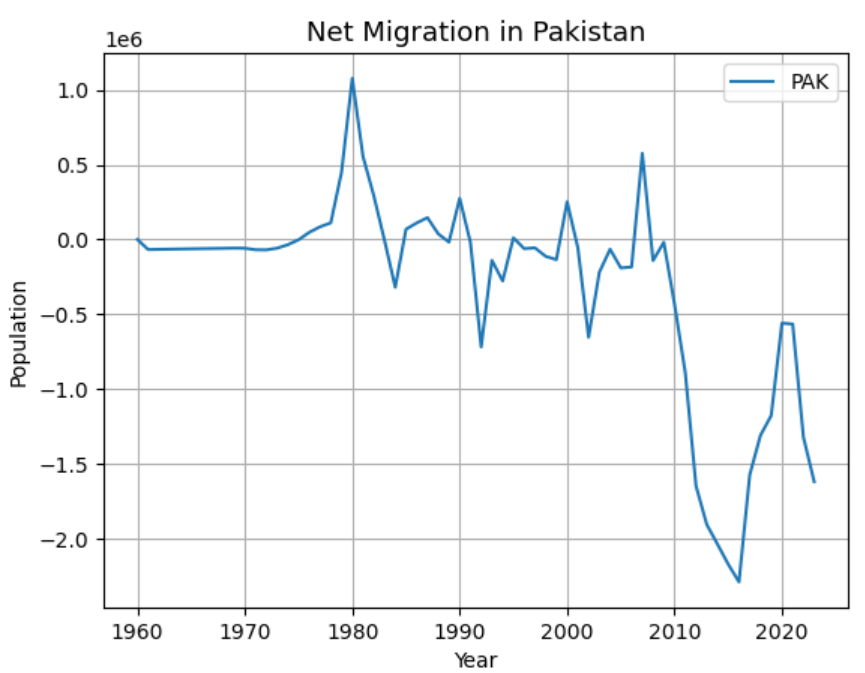
Here are the numbers of migrants in Pakistan in each year. Perhaps, it accepted anti-communist refugees from Afghanistan in the era when Afghanistan became the Democratic Republic of Afghanistan (1978 - 1992). Also, it is very surprising that the sum of the Pakistani migrants is around -19505898.0 only in 2010 - 2023. (*The emigration number is even bigger than this number because migration number is the sum of immigrants and emigrants. So, the number of immigrants is included in the number.)
It means that about 20 million Pakistani soldiers may have deployed in the world since 2010 to kill liberals. And some of such Pakistani diaspora went to UAE, Qatar and Kuwait.
Country | 1960 | 1961 | 1962 | 1963 | 1964 | 1965 | 1966 | 1967 | 1968 | 1969 | 1970 | 1971 | 1972 | 1973 | 1974 | 1975 | 1976 | 1977 | 1978 | 1979 | 1980 | 1981 | ... | 2010 | 2011 | 2012 | 2013 | 2014 | 2015 | 2016 | 2017 | 2018 | 2019 | 2020 | 2021 | 2022 | 2023 |
Pakistan | 0.0 | -66991.0 | -65780.0 | -64552.0 | -63298.0 | -62070.0 | -61025.0 | -59932.0 | -58721.0 | -57406.0 | -58281.0 | -68357.0 | -69209.0 | -58012.0 | -34785.0 | -1710.0 | 48238.0 | 85250.0 | 111386.0 | 450003.0 | 1078229.0 | 555032.0 | ... | -431902.0 | -890633.0 | -1647989.0 | -1906319.0 | -2037920.0 | -2172162.0 | -2290411.0 | -1574585.0 | -1309611.0 | -1177220.0 | -559291.0 | -565673.0 | -1322625.0 | -1619557.0 |
It is very unusual number even compared to India. In the same duration (2010-2023), total Indian migrant number is -6025113.0. This is also bigger than Chinese migrant number in the same era (-4301071.0). It is less than one third of Pakistan. Furthermore, they have very big population gap where India has 1.428 billion (0r 1428 million) and Pakistan has 255 million.
It means that Indian emigrants in the duration was about 0.4% of their total population while Pakistani emigrants amount to about 8% of the total population.


Comments