Bavaria and Austria-Hungary IV: WWI and Young Turks
- Admin Gauge
- Mar 6, 2025
- 5 min read
Background of Sarajevo Affairs
In the current history, "Sarajevo Affairs" is considered as the beginning of WWI. The suspect is mentioned as a "Serbian Revolutionist". However, we still can not understand why this incident led the WWI including Russian Revolution, Armenian Genocide by Young Turks, and German Revolution (Dissolution of Kingdom of Bavaria). So, I try to recover its context.
Sarajevo affairs include the assassination of Archduke Franz Ferdinand of Austria (prince of Austria-Hungary empire) in 1914, which led to World War I, and recent conflicts in Bosnia and Herzegovina.
The start of World War I, the so-called "Great War" of 1914 to 1918, was triggered when a teenage Serbian revolutionary shot Archduke Franz Ferdinand, the presumptive heir to the Austro-Hungarian throne, and his wife Sophie on their visit to the Bosnian capital of Sarajevo.
In 1908 (July 3-23), Young Turks Revolution started in Resen (North Macedonia) to oust Ottoman's Sultan Abdul Hamid II and recover the order of the constitution. It is noted that Janissaries were the private army of Ottoman Sultan. And This Sultan Abdul Hamid II died few months before the end of WWI. So, the battle between Young Turks and Sultan (Janissaries - Armenians) caused the "Armenian Genocide".
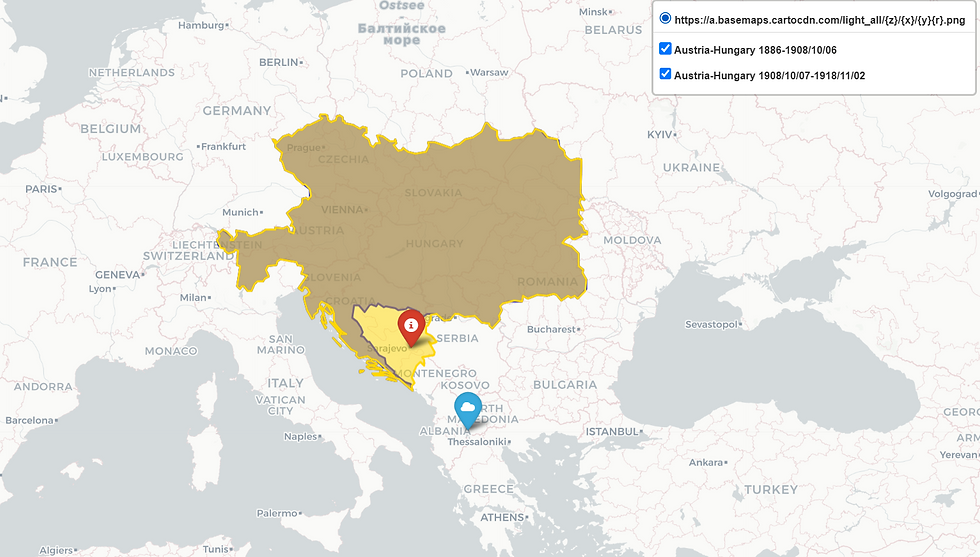
In any case, after the Young Turks Revolution in 1908, Austria-Hungary was worried about the expansion of the Revolutionist power (Young Turks). On 5 October 1908, Austria-Hungary annexed Bosnia (the expanded part of the map below).
Here is the map of Austria-Hungary Empire (gray: 1886-1908 border and yellow: 1908-1918 border), the location of Resen in North Macedonia (the original place of the Young Turks Revolution) and Sarajevo (the place of the assassination of Franz Ferdinand of Austria).
In this context, the assassination of Franz Ferdinand of Austria happened in 1914. It is very natural to assume that the Serbian Revolutionist who killed the Prince of Austria-Hungary cooperated with Young Turks.
WWI: Central Powers are Not One Faction
As I stated above, Ottoman itself had an inner conflict between Sultan (Janissaries) and Young Turks. Although the current history described as if the WWI was the battle of Central Powers (Germany, Ottoman, Austria-Hungary etc.) versus Entente (UK, France, Russia, US etc.), it seems that the structure of the WWI was more complicated.
For example, Russia had a conflict between Romanov and Revolutionists. Also, Ottoman empire had the battle - Sultan (Janissaries) versus Young Turks. In Germany, it could be the battle between Kingdom of Bavaria/ Austria-Hungary and Prussia. And it is likely that Romanov, Ottoman Sultan, Kingdom of Bavaria/ Austria-Hungary were allies of Entente.
Here is my image of the "real" structure of WWI. After the WWI, Ottoman Sultan was abolished, Russia became a republic, Kingdom of Bavaria was dissolved, and Austria-Hungary was also dissolved,. All of such people exiled to the places of Entente's colony (such as Malta, Switzerland, Madeira etc.). In addition, Hoover helped Romanov and other European imperial refugees (possibly related to Austria-Hungary and Kingdom of Bavaria) during WWI. Such people were sent to the Middle East and became the origin of Palestine refugees. So, it is likely that Entente lost the WWI to Liberals along side with their allies Sultan (Janissaries), Romanov, Kingdom of Bavaria and Austria-Hungary.

Aftermath of WWI - League of Nations
After WWI, League of Nations emerged in 1920. The organization also helped the "refugees" of WWI, who are likely to be the victims of Armenian genocide, Russian Revolution and the dissolution of Kingdom of Bavaria/ Austria-Hungary Empire. Unlike prejudice, US never became a member of League of Nations because it was rejected by the Congress.
Motivated by Republican concerns that the League would commit the United States to an expensive organization that would reduce the United States’ ability to defend its own interests, Lodge led the opposition to joining the League. Where Wilson and the League’s supporters saw merit in an international body that would work for peace and collective security for its members, Lodge and his supporters feared the consequences of involvement in Europe’s tangled politics, now even more complex because of the 1919 peace settlement. They adhered to a vision of the United States returning to its traditional aversion to commitments outside the Western Hemisphere. Wilson and Lodge’s personal dislike of each other poisoned any hopes for a compromise, and in March 1920, the Treaty and Covenant were defeated by a 49-35 Senate vote. Nine months later, Warren Harding was elected President on a platform opposing the League.
Here is the chronological chart of US president during WWI and WWII.
William Howard Taft (March 4, 1909–March 4, 1913), Republican
Woodrow Wilson (March 4, 1913–March 4, 1921), Democrat
Warren G. Harding (March 4, 1921–August 2, 1923), Republican
Calvin Coolidge (August 2, 1923–March 4, 1929), Republican
Herbert Hoover (March 4, 1929–March 4, 1933), Republican
Franklin D. Roosevelt (March 4, 1933–April 12, 1945), Democrat
Harry S. Truman (April 12, 1945–January 20, 1953), Democrat
So, the Sarajevo Affairs in 1914 happened right after the US president was changed from Republican to Democrat. When WWI ended, US was still under the Democrat regime (Wilson). However, Hoover continued to help refugees in Europe, and he became the president of US in 1929. It is noted that the resignation of Hoover (March 4, 1933) happened few weeks before the Enabling Act of 1933 in Germany (the law gave the power to make and enforce laws to Chancellor without the involvement of parliament). Also, Hoover was only one US president who met Hitler directly.
In the current history, it is said that Wilson established the League of Nations. However, I suspect that it was established by Hoover because US rejected the membership in the League of Nations in 1920 (under the presidency of Wilson). A politician can become the president only when he holds the majority seat in the congress. League of Nations was obviously the successor of Entente of WWI.
Hoover family was originally from Pfalz (the realm of Kingdom of Bavaria). And his family was one of Pennsylvania Germans. Naturally, he had a historical connection with Kingdom of Bavaria and Austria-Hungary Empire. This could be the reason why Hoover helped the "refugees" in Europe during WWI.
After WWII, Hoover faction could have been working to reconstruct infrastructure via Marshall Plan, UNRRA etc. And the key infrastructure project in Afghanistan (Helmand Valley Development Project) was also constructed based on Hoover Dam Project. Helmand Valley Project accepted the "Nomadic people" to resettle in Afghanistan, and such Nomads were likely to be Gulag fugitives and prisoners released by Khrushchev.
Hoover had been disliked by US people during WWII. And it was Kennedy who welcomed Hoover to join in the US politics again. The first director of UNRWA (the organization which aims to help Palestine refugees) was from Kennedy family, and Kennedy family had at least 3 medical soldiers on the British side during Gallipoli War (Young Turks versus Entente in WWI). USAID was also established by Kennedy to fight against "Communist" countries (war victors of WWII).
Since the end of WWII, the United Nations took over the "refugees" business by the League of Nations.
There are so many discoveries around the history of Bavaria and Austria-Hungary. I have two more topics to write related to such area. To be continued...


Comments