Soviet Gulag and Nomad Settlers in Afghanistan
- Admin Gauge
- Feb 15, 2025
- 7 min read
Updated: Feb 16, 2025
Resettlement Program by USAID in Afghanistan
I was reading some documents about the details of Helmand Valley Project. Seemingly, the project also encouraged "nomadic people" to settle down in Afghanistan. In this context, Nomadic people are Pashto and Kuchis. Afghanistan has two official languages, Dari (Persian) and Pashto. Pashto speakers are living near the Pakistan borders.
But who are such "Nomadic" people? And why did US development group want to help them? It is possible that such nomadic people also have skills to build dam, water system, etc. That is why their settlement was welcomed as a part of Helmand Valley Development Project.
I was investigating about the historical context, and I found one possibility - the Nomadic people may have run away from Soviet Gulag (forced labor camps in Soviet, mainly for war criminals and political prisoners) and arrived in Afghanistan. Soviet Gulag included Hydroprojects which constructed dam, canal, hydro power plant etc. In addition, such water related project was famous for its high rate of "runaway". As well as train construction, there were so many missing prisoners in irrigation projects because the two types of projects are related to moving and transportation. It is relatively natural to move to another place by pretending as a part of their work.
In any case, let's check the statistics of Gulag by Soviet government.
Statistics of Soviet Gulag
Gulag - Wikipedia (Due to the sensitivity of the topic, the wiki page may have been revised after I got this data.)
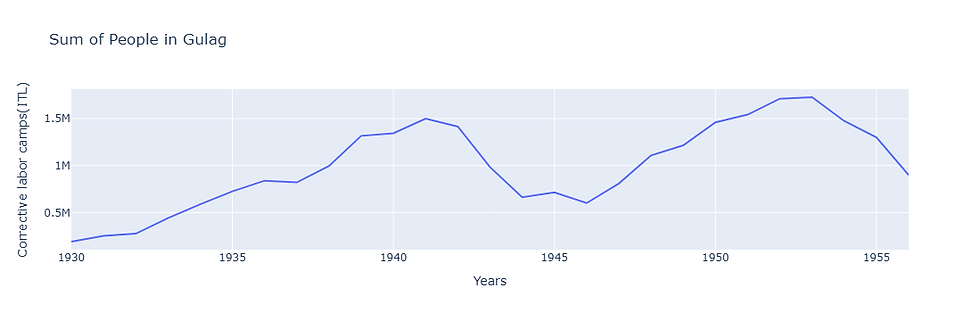
This graph is about the people who worked at Gulag. There are obviously two major drops around 1942 - 1943 (Possibly, due to Stalingrad Front or their original name "Don Front") and after 1953 (Khrushchev era). Don Front was led by anti-Stalin faction including Khrushchev and K. K. Rokossovsky. And Khrushchev released prisoners since 1953, after the death of Stalin.
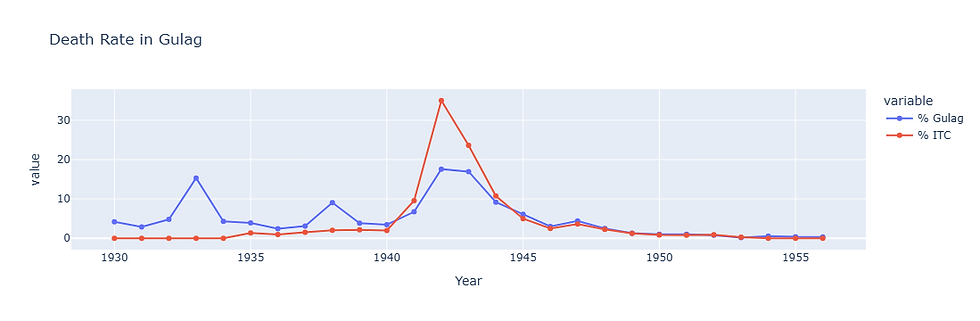
The next graph is about the death rate in Gulag. The blue line is the death rate in Gulag (Corrective Labor Camps), and the red line is that of Correctional Labor Colonies (ITC). The death rate of ITC is further higher in 1942. Also, seemingly there was a famine in 1932-1933.
Khrushchev's Amnesty for Gulag Workers
After the death of Stalin, Khrushchev started to reform the jail system in Russia. And he liberated more than 1.2 million prisoners according to the statistics.
In addition, it is said that Canal/ Dam construction, Irrigation and train construction projects in Gulag were infamous for their high rate of fugitive. Since such project deals with transportation and moving, it was very easy for them to run away from Soviet by pretending as a part of their work.
You can find lots of irrigation projects which hired Gulag workers in 1920s - 1960s, such as :
After the death of Stalin, these projects were stopped due to "humanitarian reason". But Khrushchev mainly released workers of such irrigation / canal projects. So, assumingly, they were lack of labors.
These water related infrastructure projects were often led by Hydroproject.
mhp.rushydro.ru (Official Webpage in Russian)
History of Hydroproject: История компании
You can find that Dukan Dam (Iraq, 1954-1959), Aswan Dam (Egypt, 1960s-70s), and Chernobyl Nuclear Power Plant were partly constricted by Hydroproject.
In any case, many Gulag workers (war criminals of WWII) ran away from Soviet during such water projects since 1930s, some of them may have helped by international community as "refugees". In the end, Stalin died and Khrushchev seized the power in Soviet. He released more than 1.2 million prisoners. Assumingly, many of them exiled to other countries as international development projects such as Helmand Valley Development, Dukan Dam Construction, Aswan Dam Construction etc.
And the era when Khrushchev released such prisoners are almost the same as the time when Helmand Valley Projects encouraged the settlement of "Nomads" in Afghanistan. Of course, such people can build dam and cannals very well because they worked in such fields as a part of forced labor in Gulag.
So, the origin of problematic Afghanistan "refugees" are likely to be such Nomadic people, namely, the fugitive criminals from Soviet Gulag.
Gulag during WWII (1930s-40s)
Another remarked incident within the data is the leap of the death rate in 1941-42. It seems this incident was related to the Stalingrad (Volgograd) Front by Germany. nit wants to conceal the fact.
Yesterday, I saw that this battle was originally called "Don Front", and the military advisor of Don Front was Khrushchev. However, due to the severe language control, such information was removed today.. But this incident somehow shows that such irrigation project around Volga and Don Canal was really a key factor to understand the real history and the mystery of "refugees". This is why the cyber language control became intense.
I have slightly found that English wiki mentioned Khrushchev as the
By order of the Stavka on July 12, 1942, Stalingrad Front was formed, under the command of Marshal S.K. Timoshenko, with N.S. Khrushchev as member of the Military Council and Gen. P.I. Bodin as chief of staff. Ostensibly this was simply a renaming of the now-dissolved Southwestern Front, but in fact was a largely new formation, as the only effective units under its command were the new 62nd, 63rd and 64th Armies, formed from the 7th, 5th and 1st Reserve Armies, respectively.
Also, the director of Don Front was K. K. Rokossovsky. Multiple sources mentioned that Rokossovsky was purged by Stalin as a part of the Great Purge in 1937. Hebrew information said that he was suspected as a "Japanese spy". And he was sent to a forced labor camp (which often dealt with water related infrastructure project). Most canals in the western Soviet by Hydroproject were developed during 1930s. However, now, wikipedia said that Volga-Don canal construction was started only after 1950 due to the war. I suspect that this information was also revised (falsified) yesterday due to propaganda purpose. Russian information (via Yandex search) still indicates that the project was started before the Stalingrad Front.
In 1920, according to the GOELRO plan, the government of the country again raised the issue of creating a canal. The project was prepared by the mid-1930s. Work resumed only in 1943, immediately after the end of the Battle of Stalingrad. (Translated from: https://www.prlib.ru/history/619278 - Presidential Library of Russia)
After Stalin arrested Rokossovsky in 1937, did Stalin really retrieve his trust on Rokossovsky in 1942 enough to deploy him in the leader of Don Front, which was one of the most important (and with big fatality) unit?
Revision of History in the Past Communist Countries
In Germany and Russia, history is largely revised after the fall of the communist regime. The method of falsification of history by anti-communists is based on Hellenism method (to mix truth and false information). Also, such fake history often writes as if East Germany and West Germany were in the same one country. They often write as if what West Germany did was done by East Germany (and vice versa) to make confusion. I suspect that Soviet experienced similar destruction of history. In their case, the conflicted factions were "Communist Russia or Military regime Russia (Stalin)" and "Federalist Russia (Lenin and Khrushchev).
In fact, "Federalism" is synonym of "anti-communism" . WFM (World Federalist Movement) was one of the strongest anti-communist organization in Switzerland.
And it was Lenin who adopted the term "Federative" in the name of Soviet. There are numerous name change in Soviet states. Leninist regions have "Federative" in their name such as Russian Soviet Federative Socialist Republic in SFSR while communist states are "Soviet Socialist Republics" - in USSR (the term socialist also sometimes including Hellenism - industrial revolution faction) or "Soviet People's Republics". Although they sound similar, there are very big gap between them. The difference is almost the same as the difference between Soviet Gulag (jail) and Republic (or Military regime). The police and military of Republics arrested the criminals in Gulag. The next article clearly mentioned the difference between RSFSR and USSR.
Federalist government often privatize infrastructure and it has a strong cooperation with Orthodox Christian Church. But Republics tend to have national infrastructure.
Also, Trotskists or the people who led Russian Revolution arrested orthodox priests and Christians. Anti-communists (mainly orthodox Christians) still resent Trotskists. So, I assume that there was also conflict between Trotskists and Lenin. It seems Lenin cooperated with League of Nations (1920-1946) and established Soviet "Federative" Republic in 1920. Perhaps, Lenin was hired to kill Trotskists, and swallow the new republic by a fake federalist republic. However, his leadership did not last for long and Stalin purged many of Leninists and such people were sent to Gulag. However, the current history describes as if Trotsky and Lenin were strong ally or Stalin and Lenin were sane kind of communist by using the metaphor of "Marx-Leninism". I think Marxism and Leninism had a big war within Soviet.
In any case, I got to know that water related infrastructure projects (especially related to Gulag) are one of the origin of the refugees and war.
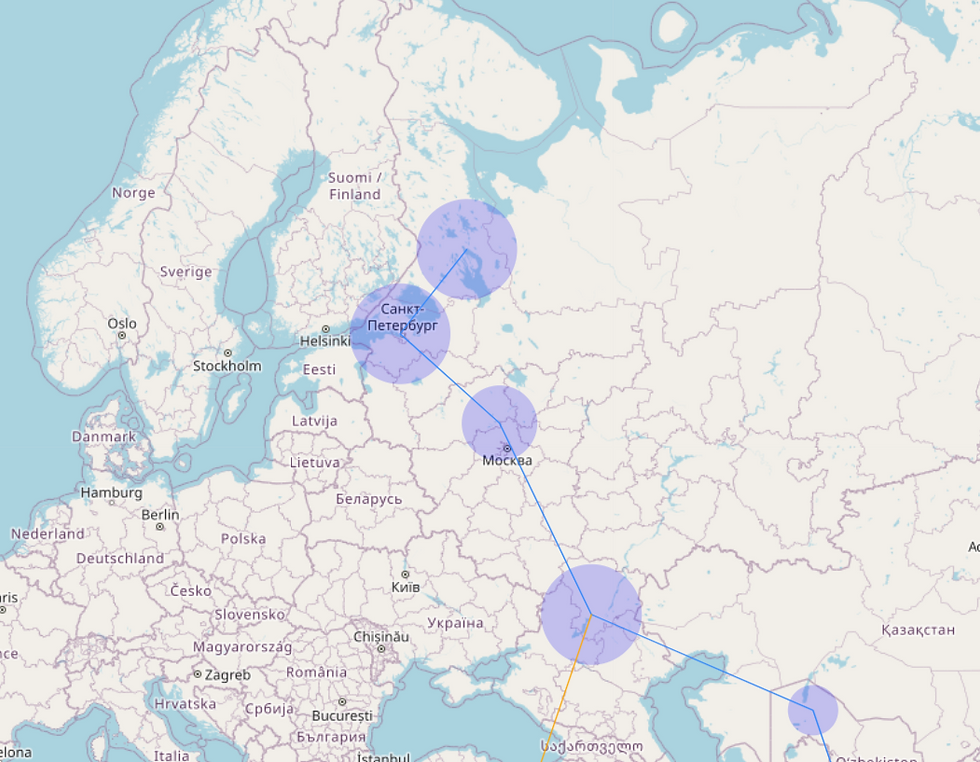
Here are the locations of the earliest irrigation projects in Soviet by Hydroproject and Gulag workers. Interestingly, the earliest Gulag was located in Solovetsky island (near the most north circle: White Sea - Baltic Canal). Perhaps, the strongest motivation of the irrigation project in Soviet was mostly "to run away from jail and forced labor camp)... Solovesky island is also the first Unesco World Heritage in Russia. It somehow shows the origin and ideology of UN and UNESCO.
I am still on the way to study history of Soviet and Gulag. It is very complicated and lots of distorted historical description. So, it may take time to understand it. But in the near future, I will write more about Gulag.


Comments