Subplot: Vichy France and Germany Occupation
- Bon Habler
- Mar 9, 2025
- 10 min read

Reality of WWII is Still Difficult to Grasp
Last time, I tried to analyze the whole view of refugee issue during WWII. However, it was extremely difficult to find a consistency. So, I am sorry that the article and the topic are still very messy. Maybe I will update it after I grasp the outline.
By having difficulty to understand the reality of refugee issue during WWII and the post war, I found a local consistency around Vichy France. When one can not understand the whole, it is better to go back to the local parts.
Was Vichy an Ally of "Nazis"?
In the current history, Vichy France is often regarded as an ally of Nazis. However, Phillipe Petain (the leader of Vichy France) was a soldier who mainly fought against Germany during WWI. He cooperated with Entente to fight against Germany. Namely, he is an alliance of Austria-Hungary, but an enemy of Prussia.
This is the locations of the battles which Petain was involved in during WWI. Red is the victory of Entente (Petain), Blue is the victory of Prussia, and Green is undetermined result. (Battles: First Battle of Guise - Aug 1914, Battle of the Marne - Sep 1914, Battle of Artois - June 1915, Second Battle of Champagne- Nov 1915, Battle of Verdun - Dec 1916, Operation Michael - Mar 1918, Second Battle of the Marne - July 1918)

In Nov 1942, Germany and Italy occupied France (Case Anton or Operation Anton). This is the map of the German occupation and the area of Vichy France (Free France). Why is the area of Vichy France called "Free" France although Vichy regime is regarded as a kind of war crime regime? You can easily find that the areas where Petain fought against Germany became under German occupation. It clearly shows that Vichy and Germany (maybe anti-Entente side during WWI) had a war, but they are not allies. Also, Strasbourg (the parliament of EU) was annexed by Germany.

Vengeance by Allied (Entente) in 1943
After Germany occupied the north part of France, Allied Power (in fact, it was still the Entente of WWI) invaded Italy (Allied Invasion of Italy) in 1943. They invaded Italy from North Africa because they conducted North African Campaign in 1940 - 1943.
Remember that MERRA was established in 1942, and the refugees of WWII (caused by the Soviet/ Germany occupation in Europe) were also sent to North Africa. It is very natural to assume that such "refugees" in North Africa were reused as soldiers to invade Italy in 1943.
The Middle East Relief and Refugee Administration (MERRA), established by the British in 1942, placed around 40,000 Europeans in camps set up in Syria, Egypt and Palestine.
During the second world war, the Middle East Relief and Refugee Administration (MERRA) operated refugee camps in Morocco, Algeria, Egypt, Syria and Palestine for people fleeing the war in Europe.
In any case, Allied Forces invaded Italy in September of 1943. Interestingly, this invasion was led by Eisenhower (the future US president in 1953-1961, who cooperated with Khrushchev to release Gulag prisoners). Eisenhower is also a Pfalz origin Pennsylvania German.
The Allied Campaign in Italy, 1943-45: A Timeline, Part One | The National WWII Museum | New Orleans
July 9-10 Operation Husky, the Allied invasion of Sicily, begins under the overall command of General Dwight D. Eisenhower.

In addition, Eisenhower was a supreme commander of the North African Campaign since 1942. At that time, he contacted with Vichy France.
Perhaps, he was one of the "refugees" who were helped by MERRA and sent to a refugee camp in North Africa. And then, he might have been reused as a soldier to invade Italy by Allied Forces. MERRRA mainly helped the people who were purged by Germany and Soviet since 1939. As I mentioned in the last article, it largely contained the "Volga Germans" who constructed the Volga- Don canal. Eisenhower is exactly the Pennsylvania (Pfalz) German origin.
In November 1942, Eisenhower was also appointed Supreme Commander Allied Expeditionary Force of the North African Theater of Operations (NATOUSA) through the new operational Headquarters Allied (Expeditionary) Force Headquarters (A(E)FHQ).
Note: The Spanish information about this North African campaign is very detailed because it seems that this campaign is deeply linked to the Gibraltar issue and other North African issue in the modern sense. Eisenhower set the main naval base of this operation in Gibraltar. Spain was also under military regime (Franco). And Franco was on the side of Germany and Soviet.
Aftermath of Allied Invasion of Italy
In the current history (revised a lot since the Cold War), it is said that Allied Forced won this campaign and occupied Italy.
However, there are two major points which indicate that the result may have been different.
Phillipe Petain was captured by "Germans" and died in Île d'Yeu (penal colony of France)
The following are the explanation about the end of Petain regime in Britannica and Wikipedia respectively. In both explanation, I feel that de Gaulle was cooperated with Germany and Germany - de Gaulle alliance arrested Petain (Vichy France). And it is called the liberation of France. Seemingly, a trial was set to him to judge his treason by de Gaulle. And the, he was sent to the penal colony - Île d’Yeu.
In August 1944, after the liberation of Paris by General Charles de Gaulle, Pétain dispatched an emissary to arrange for a peaceful transfer of power. De Gaulle refused to receive the envoy. At the end of August the Germans transferred Pétain from Vichy to Germany. Brought to trial in France for his behaviour after 1940, he was condemned to death in August 1945. His sentence was immediately commuted to solitary confinement for life. He was imprisoned in a fortress on the Île d’Yeu off the Atlantic coast, where he died at the age of 95.
Following the liberation of France, on 8 September 1944, Pétain and other members of the French cabinet at Vichy were relocated by the Germans to the Sigmaringen enclave in Germany, where they became a government-in-exile until April 1945. Pétain, however, having been forced to leave France, refused to participate in this government and Fernand de Brinon now headed the "government commission".[64] In a note dated 29 October 1944, Pétain forbade de Brinon to use the Marshal's name in any connection with this new government, and on 5 April 1945, Pétain wrote a note to Hitler expressing his wish to return to France. No reply ever came. However, on his birthday almost three weeks later, he was taken to the Swiss border. Two days later he crossed the French frontier The provisional government, headed by de Gaulle, placed Pétain on trial for treason, the trial taking place from 23 July to 15 August 1945. Fearing riots at the announcement of the sentence,[clarification needed] de Gaulle ordered that Pétain be immediately transported on the former's private aircraft to Fort du Portalet in the Pyrenees,[69] where he remained from 15 August to 16 November 1945. The government later transferred him to the Fort de Pierre-Levée citadel on the Île d'Yeu, a small island off the French Atlantic coast
Here are the location of Île d’Yeu (red) and Sigmaringen (green). The island is in the typical location for a penal colony. Also, the location of Sigmaringen in similar to the self-declared "French occupation area" of Germany after WWII. According to the falsified history, the area under Stuttgart was occupied by France. But the area was a prison for war criminals of Vichy France.

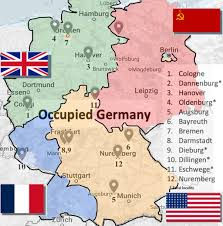
Petain was an ally of Eisenhower during the Allied Invasion of Italy in 1943. Then, who were the people who purged Petain? Surely, it is not an "Allied" forces like Eisenhower because they were allies of Petain. I suspect that Germans and German ally (de Gaulle?) invaded the Vichy France from the North occupied zone, arrested Petain and sent him to the penal colony island. But history has been falsified after Eisenhower - anti-communist faction committed a coup against the post-war liberal government (it is called the Cold War).
Eisenhower was exactly within the scope of 1948 Displaced Persons Act
Let's see the definition of "Displaced persons" who were helped by US again. Does it mean that such "displaced persons" fought against Germany, Austria or Italy during Sep 1, 1939 - 22 Dec, 1945?
For example, if Allied forces (Entente) lost the war in the real history, Eisenhower was exactly within the cope of displaced persons act. He entered in Italy for the Allied Invasion of Italy in Sep, 1943 and he could have stayed in Italy or Allied occupation area.
who on or after September 1, 1939, and on or before December 22, 1945, entered Germany, Austria, or Italy and who on January 1, 1948, was in Italy or the American sector, the British sector, or the French sector of either Berlin or Vienna or the American zone, the British zone, or the French zone of either Germany or Austria
So, it seems this 1948 Displaced Persons Act mainly wanted to help "allied soldiers" who invaded Italy, and fought in Germany/ Austria from Sep 1, 1939 to 22 Dec, 1945.
Question: Why didn't the mass purge of "Germans" after WWII include France?
I noticed one more important fact.
In the last article, I introduced one website which explains the detail of the expulsion of Germans after WWII. However, this website does not include the information about the expulsion of Germans from France although North France was occupied by Germany. If Germans were purged as war criminals, it should include the case of North France. It also implies that Germany and Soviet won the WWII and liberated France from Vichy regime.
The later stages of World War II, and the period after the end of that war, saw the flight and forced migration of millions of German nationals (Reichsdeutsche) and ethnic Germans (Volksdeutsche) from various European states and territories, mostly into the areas which would become post-war Germany and post-war Austria. These areas included pre-war German provinces which were transferred to Poland and the Soviet Union after the war, as well as areas which Nazi Germany had annexed or occupied in pre-war Poland, Czechoslovakia, Hungary, Romania, northern Yugoslavia and other states of Central and Eastern Europe.
Also, such "Expulsion of German ethnic group" started since 1944 (still during WWII). Here are some examples of each country's case. The following case is about Hungary. Communist regime purged German ethnic group such as "mining workers". And such German speaking Hungary citizens were sent to west Germany until 1948. Other groups were sent to East Germany.
(Hungary) In contrast to the expulsions from other states, the expulsion of the Germans from Hungary was dictated from outside the nation,[56] and began on 22 December 1944 when the Soviet Commander-in-Chief ordered the expulsions. On 29 December 1945, the communist Hungarian Government ordered the expulsion of everyone who had declared himself a German in the 1941 census, or had been a member of the Volksbund, the SS, or any other armed German organisation. Accordingly, mass expulsions began.[39] The rural population was affected more than the urban population or those ethnic Germans with needed skills, such as miners.[58][59] The first 5,788 expellees left from Budaörs (Wudersch) on January 19, 1946.[58] About 180,000 German-speaking Hungarian citizens were deprived of their citizenship and all possessions, and expelled to the Western zones of Germany.[60] Up to July 1948, a further 35,000 people were expelled to the Eastern zone of Germany
The next is the case of Romania. The purge also started during WWII (1944). And it was Soviet who led the expulsion of "ethnic" Germans.
(Romania) The flight of ethnic Germans from Romania began in the fall of 1944.[39] Early in 1945, Soviet occupation forces began the forced expulsion of ethnic Germans. 213,000 of Romania's ethnic Germans were eventually evacuated, expelled, or emigrated. As with all of the population migrations at this time, some lost their lives in the process. Of a pre-war ethnic German population of 786,000, about 400,000 resided in Romania in 1950. There were still 355,000 in 1977. During the 1980s many started to leave the country, with over 160,000 leaving in 1989 alone. By 2002, the number of ethnic Germans was 60,000 citizens.[39][50]
The next is Yugoslavia. The 500000 German-speaking people in Yugoslavia went to Austria and West Germany. And they were exactly within the scope of 1948 Diplaced Persons Act.
After World War II, the majority of the roughly 500,000 German-speaking people in Yugoslavia (mostly Danube Swabians) left for Austria and West Germany.[39] After 1950, thanks to the "displaced persons" act (of 1948), they were also able to emigrate to the USA. Because of the support of some ethnic Germans for Nazi Germany, for instance, enlistment in the 7th SS Volunteer Mountain Division Prinz Eugen, all ethnic Germans suffered persecution and sustained great personal and economic losses.[39] Many were killed as local populations and partisans took revenge for Nazi atrocities,[39][95] in mass rapes and detention in concentration camps.[95] At least 5,800 were shot;[96] those surviving were compelled to forced labour.[96]
By comparing the definition by the 1948 Displaced Persons Act, such people entered in Germany, Austria and Italy during 1939-1945*. However, such people started to ran away from Germany, Austria and Italy and scattered to East Europe. So, Stalin ordered East European governments to deport such fugitives(until 1948). And they were sent to both of Western occupied Zone and Soviet Occupied Zone.
*The condition is connected with "and". So, the displaced person have to satisfy both conditions.
who on or after September 1, 1939, and on or before December 22, 1945, entered Germany, Austria, or Italy and who on January 1, 1948, was in Italy or the American sector, the British sector, or the French sector of either Berlin or Vienna or the American zone, the British zone, or the French zone of either Germany or Austria
Since the first condition is "stayed in Germany, Austria or Italy", I think that this act mainly wanted to help the Allied soldiers who cooperated to fight against Germany and Italy during 1939-1945. And as I mentioned above, the "French occupied Zone" was just a prison for the war criminals of Vichy France. I suspect that US occupied zone was also a jail for war criminals from US such as Eisenhower. If Eisenhower (Pfalz German origin) lost the war and ran away to East Europe to avoid being arrested by Germany or Soviet, he was likely to be counted as the displaces person.
Also, were the "displaced Persons" really only ethnic Germans and German speakers? I suspect that there were many English speakers and French speakers too. That could be why they accepted lots of refugees after 1951 according to UNHCR's data. Pennsylvania(Pfalz origin) Germans from US can speak German. But the Entente was originally started by UK, France and Russian empire (Romanov).
History is still falsified a lot. After I investigate some local cases, the truth may appear...


Comments