Yugoslavia IV: Ustasha & Chetnik
- Admin Gauge
- Apr 13, 2025
- 8 min read
Ustasha versus Chetnik - Major Conflict in Yugoslavia
I have investigated various wars. In most cases, it is relatively easy to find the structure of the conflict such as communist versus anti-communist, secularists versus Christianity etc. However, I feel that Yugoslavia war is one of the most complicated war which is extremely difficult to understand. The historical description about Yugoslavia is severely destroyed. So, there are often two conflicted information (maybe spies intentionally write lies on such articles).
However, I found relatively visible structure of the conflict. - Ustasha versus Chetnik. Roughly speaking, Ustasha is pro-communist, pro-Young Turks, or pro-Prussia organization while Chetnik is anti-communist, pro-orthodox Christian churches, or pro-Habsburg monarchists.
Ustasha is originally from Croatia while Chetnik was based on Serbia and Kingdom of Yugoslavia. Yugoslavia became a communist state after WWII, and the monarchy system was abolished. So, pro-Ustasha faction governed Yugoslavia since then (until the dissolution of the Socialist Yugoslavia in 1991).
After WWII, such Chetnik members also exiled to US as a part of Displaced Persons Act. For example, Momčilo Đujić was one of the important example. In wikipedia, it is writeen as if he cooperated with Italy and Germany, but such falsification of history happened after the Yugoslavian war in 1990s, and it is criticized as historical revisionism. So, his role in WWII was de fact concealed. If he cooperated with "Germany" and "Italy" it was likely that he cooperated with Austria/ Bavaria and Tirol (the past Austrian empire part of Italy) or South Italy after the Allied Invasion of Italy in 1943 (occupied by Eisenhower).
Momčilo Đujić[a] (Serbo-Croatian Cyrillic: Момчилo Ђујић, pronounced [mǒmtʃiːlo dʑûːjitɕ]; 27 February 1907 – 11 September 1999) was a Serbian Orthodox priest and Chetnik vojvoda. He led a significant proportion of the Chetniks within the northern Dalmatia and western Bosnia regions of the Independent State of Croatia (NDH), a fascist puppet state created from parts of the occupied Kingdom of Yugoslavia during World War II.
Despite of numerous fabrications of history, the most concrete fact is that Dujic exiled to US in the end of 1940s. He was sent to a refugee camp in Germany in 1945, after that, exiled to Paris (1947-49) first, and then, moved to France. He was sentenced death penalty by Yugoslavian court, however, US protected him. So, it is exactly an example of "Displaced Person" or "refugees" under UNHCR.
Timeline of the Yugoslavian Wars
After the death of Tito, Yugoslavian politics became unstable.
In 1986-89, Dujic (the key person of Chetnik, I mentioned above) ordered to expel all Croats, Albanians and other foreign elements (maybe the pro-Ustasha faction) from the land of Serbia. Of course, Dujic stayed in US at that time, and it was under Bush (father) regime.
1986–1989 A controversial memorandum from the Serbian Academy of Sciences and Arts protests the status of Serbia in Yugoslavia. Serb chetnik (archduke) Momčilo Đujić (in emigration), promotes Vojislav Šešelj to Chetnik duke by declaration in the USA on Vidovdan, 28 June 1989, a Serbian religious holiday. In his instructions to Šešelj, Đujić orders him to "expel all Croats, Albanians and other foreign elements from the holy Serb ground".[1] Perceived prosecution of Serbs by Kosovo Albanians fuels growing Serbian nationalist sentiment. Additional police forces are sent to Kosovo.
As a response from the legal government, Milosevic declared to protect such Croats, Albanians etc. However, Milosevic is a person from Montenegro and he often traveled to Paris and New York (Entente places). So, perhaps, this action may have been conducted by another person, but history was falsified. Mysteriously, both of Milosevic and Seselji (appointed by Dujic) were charged by the Yugoslavian War Criminal Court after the wars.
Slobodan Milošević, a high government official at the time, gives a speech to a small group of Kosovo Serbs where he promises that "no one will beat them", which is aired in the main television news programme. Milošević instantly becomes very popular in Serbia. Milošević rises to power in Serbia.
UNHCR Data around Yugoslavia
Here are the data about refugee acceptance in "Serbia and Kosovo". Although the country Serbia did not exist during the socialist Yugoslavia era (1945-1991) and the Yugoslavian wars era, mysteriously, it accepted some refugees since 1960s. Assumingly, this statistics "Serbia and Kosovo" is almost the same as the revival of "Kingdom of Yugoslavia".

Here is the magnified graph about such refugee acceptance in "Serbia and Kosovo" (1960s-70s). The early refugees to the "Serbia and Kosovo" came from Greece, Albania (maybe the past kingdom side), Hungary (maybe Habsburg faction in the time of Austria-Hungary empire), Russia (only in 1966) and origin unknown. I am not sure why the refugees from Greece were counted as Russian origin refugees only in 1966 although the numbers are obviously similar. But it might be related to the Greek military coup in 1967.

Before such refugees went to "Serbia and Kosovo", many of them were in Greece. However, Greece itself accepted "origin unknown" refugees since 1951. And the origin unknown refugees in Greece gradually disappeared since 1966, the year "Serbia and Kosovo" started to accept refugees from Greece. So, such people are the Displaced Persons (war criminals of WWII).
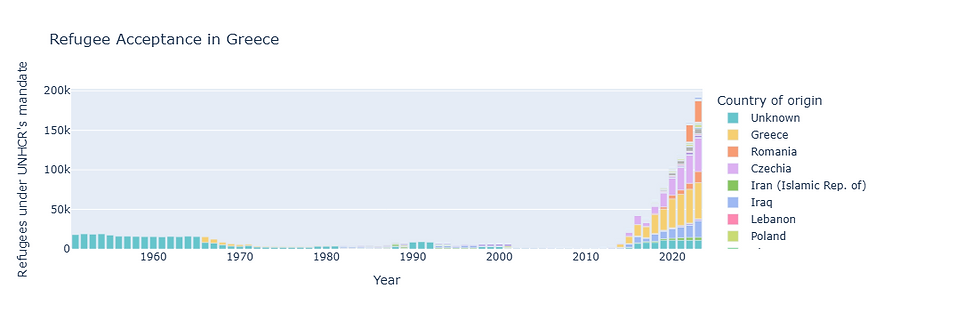
Since 1965 (there were already political crisis related to the military coup in 1967), some people from Greece became refugees and moved to "Serbia and Kosovo" or became internal refugees. Mysteriously, the refugees to Serbia and Kosovo disappeared only in 1966 just like the data of "Serbia and Kosovo". Perhaps, due to the high risk of mass arrest by the Greek Junta, the refugees pretended as Russian refugees only in 1966. If they pretended as "Russian" it is likely that they were related to orthodox Christianity (priests etc.).

The following graph is about the refugees originated in Albania. You can find that Albania started to send refugees to "Serbia and Kosovo" since 1965. Albania also had kingdom era (1928-39), and it was dissolved by the German (communist or Prussia) invasion. The Albanian king Zogu exiled to Greece, Egypt, UK, and then, France (Nice). The places of his exile are very similar to the last king of the kingdom of Yugoslavia, Peter II. Zogu's father had a strong relationship with Sultan (the enemy of Young Turks) and he tried to cause a rebellion against Ottoman. So, he was killed in 1911, suspected by the young turks faction.
The Greek junta coup may have affected on the politic of Albania too. Their refugee trend in 1960s and 1970s are very similar to Greece. And such monarchist (pro-kingdom of Yugoslavia) side of Albanians tend to exile to US, UK, and France recently.

So, assumingly, UN (the successor of Entente of WWI) and its alliance prepared for the revival of the kingdom of Yugoslavia since 1960s by moving "refugees" to the "Serbia and Kosovo". Such refugees (war criminals of WWII) were reused to cause the dissolution of the Socialist Yugoslavia, in 1991. And then, UN established the peacekeeping unit UNPROFOR in 1992. Recently, UN peacekeeping force itself is suspected as a terrorist unit.
January 1992 Vance peace plan signed, creating 4 UNPA zones for Serb-controlled territories, and ending large scale military operations in Croatia. UNPROFOR forces arrive to monitor the peace treaty. - Timeline of the Yugoslav Wars - Wikipedia
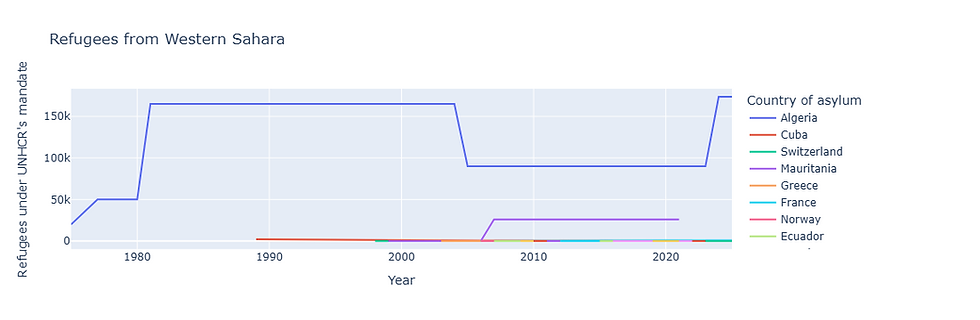
The members of UNPROFOR is full of the Jesuit/ Palestine/ Greek monarchists kind of war criminals of WWII. The UN secretary general (1992-1996), Butros Ghali was an Egyptian Coptic church Christian (British colonist). In his era, Somalia inner war, West Sahara, Rwanda genocide, Yugoslavian war, Israeli withdrawal from Egypt in 1970s etc. were intensified. His grandfather was a past Egyptian prime minister during the British Mandate era, and he was killed. The first director of UNPROFOR was an Indian person who had linked to Jesuit/ Colombo Plan. It is noted that the refugee issue in Balkan became intensive only after the establishment of UNPROFOR.
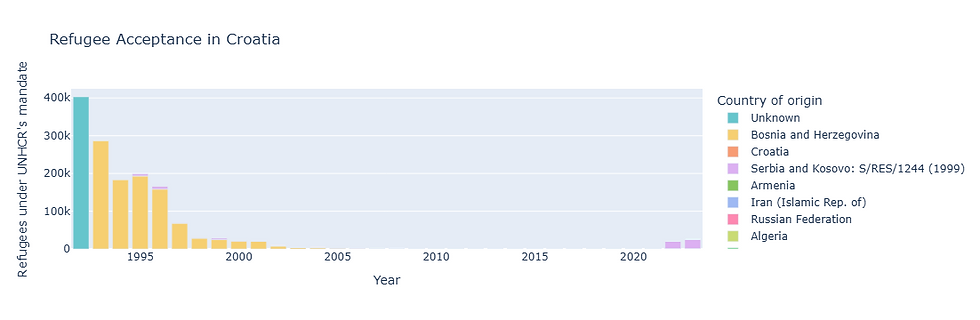
The UNPROFOR dealt with the peacekeeping mission in Croatia, Macedonia and Bosnia/Herzegovia originally (1992). It is the same year when Croatia suddenly accepted 400k refugees (origin unknown) in 1992. So, the UNPROFOR peacekeeping unit included or hired such 400k Gulag fugitives.
The United Nations Protection Force (UNPROFOR; also known by its French acronym FORPRONU: Force de Protection des Nations Unies) was the first United Nations peacekeeping force in Croatia and in Bosnia and Herzegovina during the Yugoslav Wars. The force was formed in February 1992 and its mandate ended in March 1995, with the peacekeeping mission restructuring into three other forces (the United Nations Preventive Deployment Force (UNPREDEP) in the Republic of Macedonia, and the United Nations Confidence Restoration Operation in Croatia (UNCRO) in Croatia, with restructured UNPROFOR operations ongoing in Bosnia and Herzegovina until their replacement by NATO and EU missions in December 1995).
So, UN cooperated with the Republic of Serbian Krajina (Serbian faction in Croatia) to deploy refugees (terrorists) in Croatia.
UNPROFOR was created by UN Security Council Resolution 743 on 21 February 1992 during the Croatian War of Independence.[3][4] The initial mandate of UNPROFOR was to ensure stable conditions for peace talks, and security in three demilitarized "safe-haven" enclaves designated as United Nations Protected Areas (UNPAs). These were located in various regions before the Republic of Croatia received full membership status in the United Nations (UN), but were controlled by the self-styled Republic of Serbian Krajina.[5]
In Croatia, UN - Entente deployed Gulag fugitives (about 400k) in 1992. Assumingly, it included lots of Chetnik soldiers. And it was managed by the Serbian-Krajina faction.
In North Macedonia, they deployed "origin unknown" refugees (Gulag fugitives) in 1992 and invaded North Macedonia. UNPROFOR had troops on Macedonia too. It was targeted because North Macedonia was the original place of the Young Turks Revolution.

In "Serbia and Kosovo", the refugee crisis started in 1992.And they started to deploy the Gulag fugitives (origin unknown refugees) since 1993. The refugees mainly came from Bosnia and Croatia, so, they are the IDP and the origin unknown refugees.
In Bosnia, such refugees are counted as IDP (Internal Displaced Person), and the number exceeded 1 million. This crisis also started in 1993.

In Slovenia, the refugee crisis also started in 1992. And the refugees mainly came from Bosnia and Herzegovina.

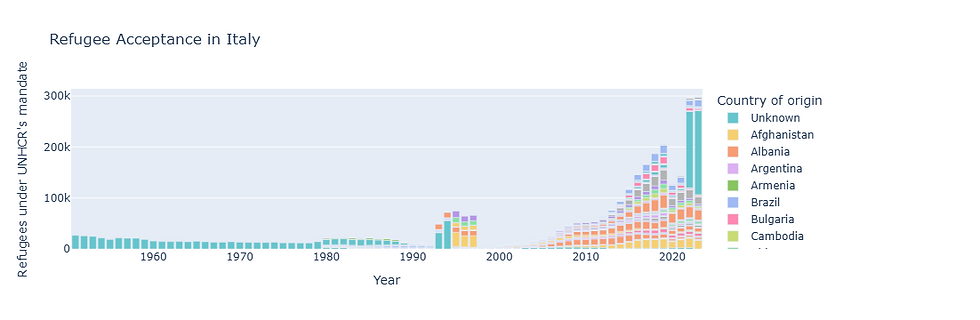
In Italy, the origin unknown refugees already existed since 1951. However, there was also a leap of refugee acceptance around 1993. In 1993, the three biggest origins of such refugees were unknown (32016), Somalia (10718), Iran(2227). The Iranian refugees in this context are the Afghanistan refugees (Gulag fugitives) who exiled to Iran after the Saur Revolution in 1978. In 1994, the numbers increased more, but the top origins were the same.
Albania is relatively fighting against the invasion by refugees, perhaps it is because it is a Muslim majority country. Or, due to such geopolitical risk, they chose Islam. Good Luck for Albania.

In summary, pirates refugee soldiers arrived around Croatia, Bosnia/ Herzegovina, Macedonia and Italy as "origin unknown refugees" in 1992, soon after UN established the peacekeeping mission. It is very likely that UN (Coptic church/ British Mandate Secretary General at that time) deployed "origin unknown" refugees (war criminals of WWII) as soldiers in such area. The UNPROFOR cooperated with/ was managed by Serbian Krajina faction in Croatia. And then, they had spread to the neighbor countries to cause the war. So, it seems UN cooperated with Serbian monarchists to cause the fall of Socialist Yugoslavia and Yugoslavian wars in 1990s.
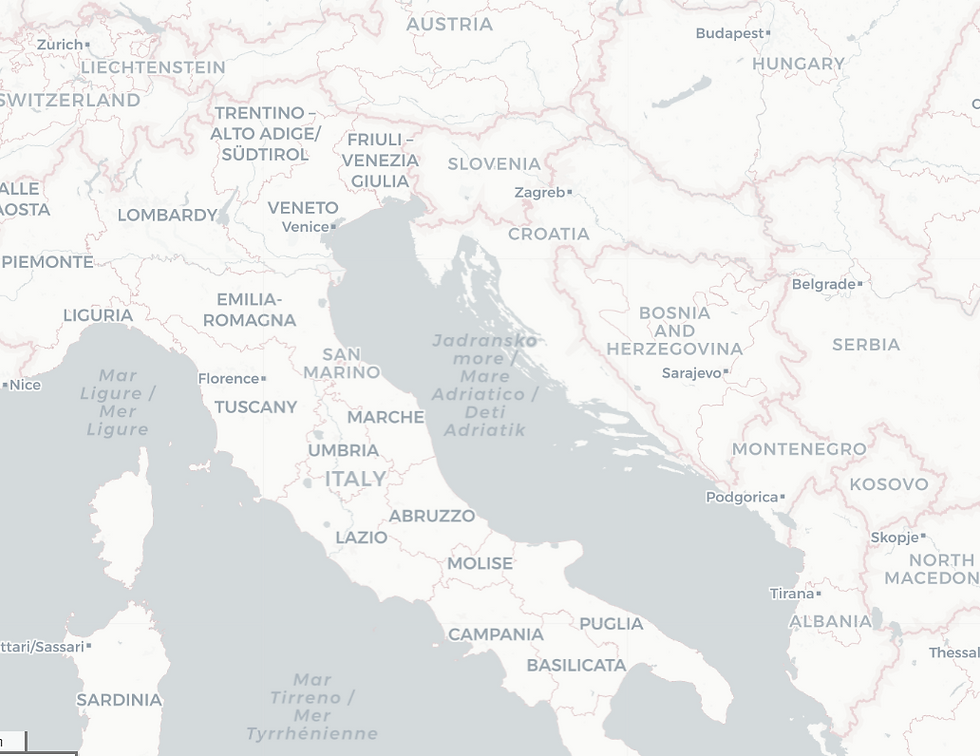
I will go to a midterm travel to the Middle East and East Europe for months. I hope that the structure of the Yugoslavian wars will become clearer during the journey. See you.


Comments