Bavaria and Austria-Hungary VI: Danzig & Kaliningrad
- Admin Gauge
- Mar 13, 2025
- 6 min read
Two Enclaves - Danzig and Kaliningrad
The WWI was said to have started in Sarajevo. And the beginning of WWII is regarded as the German invasion in Westerplatte (in Danzig). Since the end of WWI, Entente occupied (invaded?) Poland and established the Second Polish Republic in 1918.
This is the border change of Prussia (Germany) in 1919. Gray part is Prussia (1886), and blue one is the border since 1919. It shows how the League of Nations dominated Poland, Danzig, and Strasbourg area. It is still uncertain if this was really as a partition by the League of Nations, or as a usage for prisons, or as an invasion. In addition, this source of map does not consider the "Kingdom of Bavaria". According to the current history, Kingdom of Bavaria was regarded as an independent country since 1806. However, in some information, Bavaria and Prussia were regarded as a regional unit of "German Empire" (Second Reich), which was a successor of the Holy Roman Empire.
Although this source of map write as if this border was that of Germany (Prussia), perhaps, they just wrote the border of German Empire.
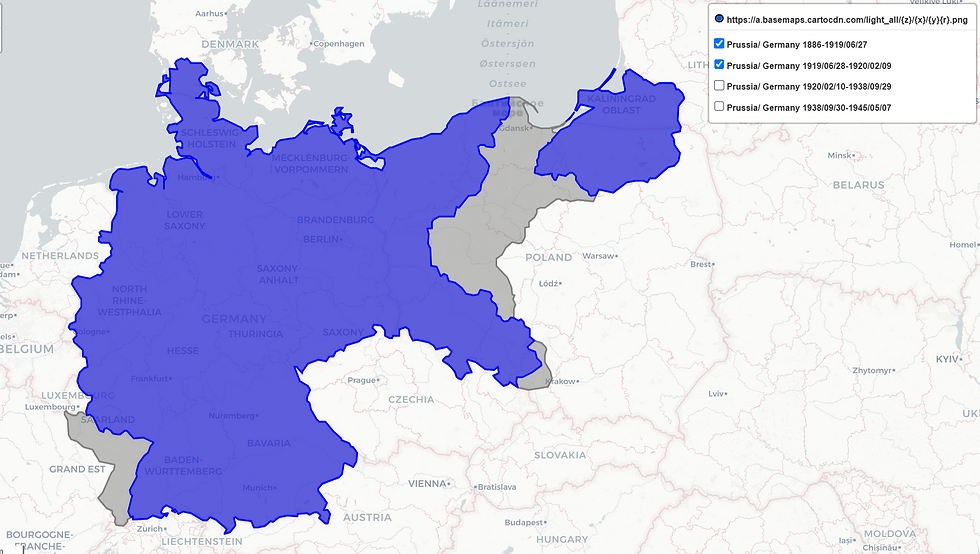
In any case, according to the official history, the League of Nations occupied Poland and established the Second Polish Republic in 1918. In almost the same year, Danzig became a semi-independent state accredited by the League of Nations.
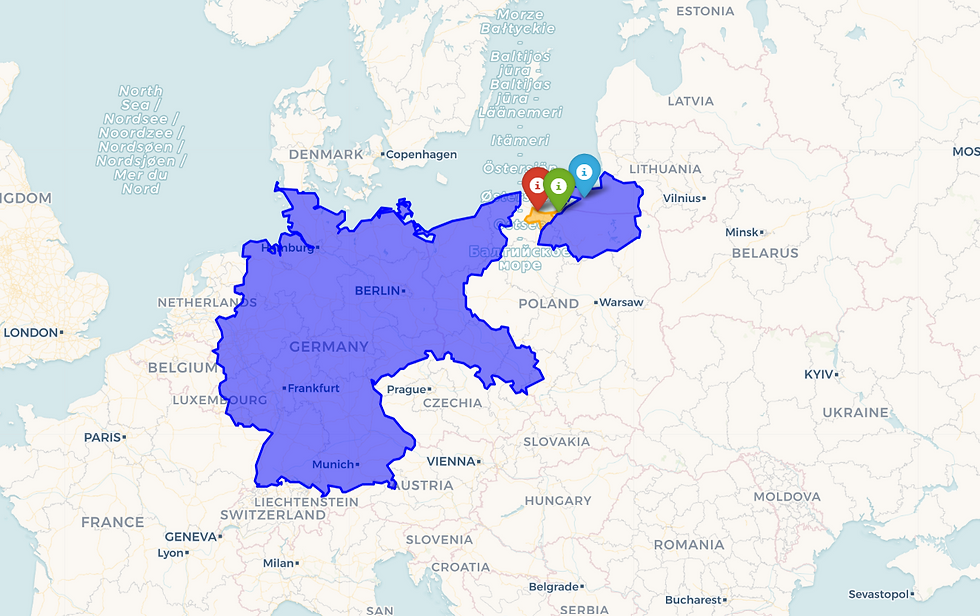
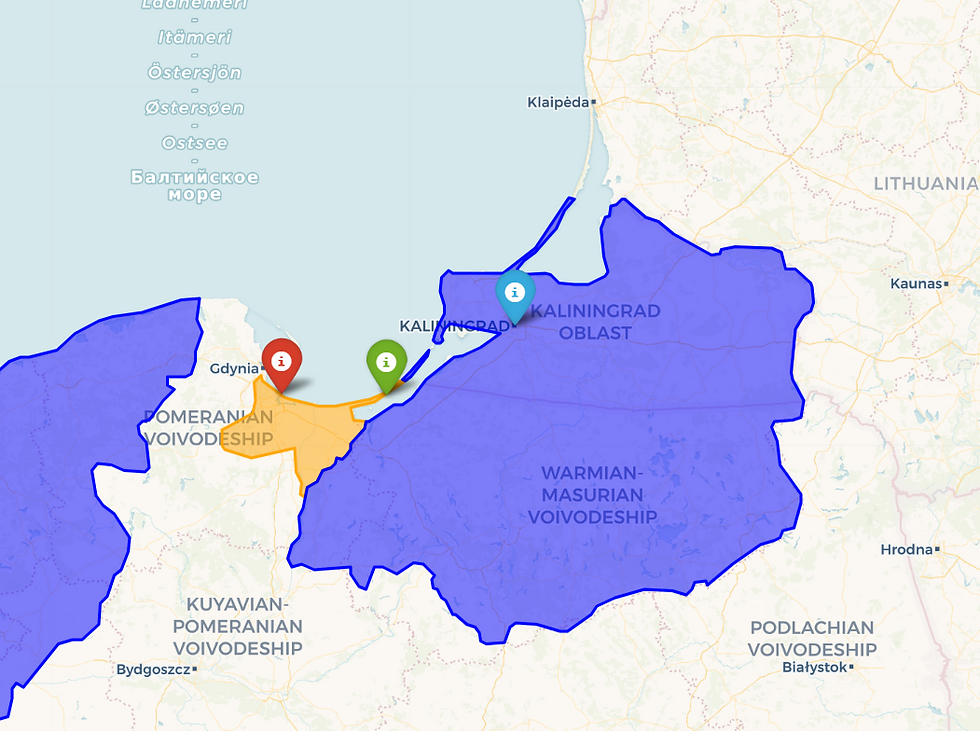
The League of Nations even established a warehouse for ammunition in Danzig (Westerplatte in the red pinned place in the map above). Assumingly, the League of Nations also welcomed the refugees of WWI (including Habsburg, Romanov, Orthodox Christians, Mennonite Christians etc. who were purged by Russian Revolution and German Revolution). Also, Volga- Baltic Waterway expanded its water electric system since 1922 as a part of Lenin's GOELRO. This project was also stopped by Stalingrad Front. It is likely that Gulag prisoners moved with this water way, and arrived around Poland and Danzig. So, the Entente established an anti-Germany reconquista hub in Poland and Danzig (and also in Strasbourg, perhaps).
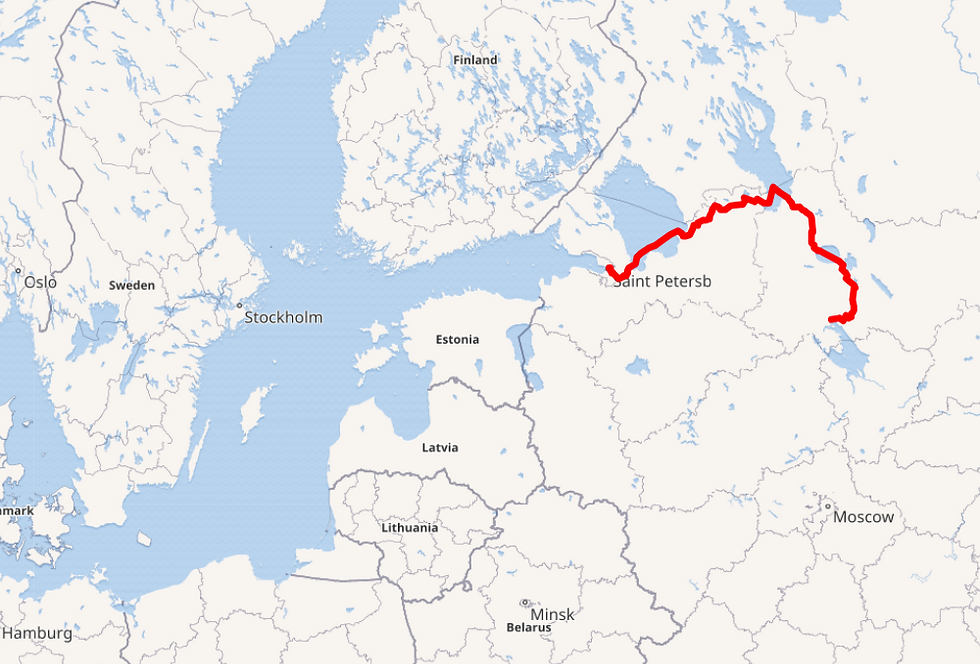
Because of such hostile activity, Germany invaded Westerplatte on 1 September, 1939, and annexed Danzig on 2 September, 1939. This battle (Battle of Westerplatte) is regarded as the beginning of the WWII.
Historical Context of WWII - Population Exchange Agreement
Germany annexed Austria, Bohemia and Moravia until 1939. In this context, Germany "invaded" Westerplatte (Danzig). Few weeks after the invasion, Germany and Soviet made an agreement about their population exchange. This population exchange may have functioned for Germany to deport German Diaspora (including "Volga-Germans", perhaps fugitive Germans) to their own realm (to avoid spreading their crime). The description of their treatment is similar to the classification of "suspects" or "criminals" (in the quotation below). Since the population exchange agreement, the "German invasion" (deportation of German diaspora based on the population exchange?) became active. Stalin Soviet also conducted Great purge since 1936 and he fought against Volga Germans (irrigation constructors). Such Volga Germans were sent to Poland and Germany, maybe due to this population exchange agreement.
The transported ethnic Germans were initially kept in camps for racial evaluation, to prevent intermixing with the native German population.[8] There they were divided into groups: A (Altreich), who were to be settled in Germany and allowed no farms or businesses (to allow for closer watch), S (Sonderfall), who were used as forced, and unpaid workers, and O (Ost-Fälle), the best classification, to be settled in the 'Eastern Wall'—the occupied regions to protect Germans from the East—and allowed independence (***High possibility of falsification).[9] This last group, after spending some time in refugee camps in Germany, were eventually brought to Polish areas annexed by Nazi Germany and to Zamość County, as decided by the Generalplan Ost. German–Soviet population transfers - Wikipedia
The places where the ethnic German came from (due to the population exchange) were almost the same as the countries where Germany "invaded" since 1940. Was the deportation of "Ethnic Germans" caused by Germany himself (by cooperating with Stalin)?
Ethnic Germans Resettled by Nazi Germany 1939–1944
Ethnic Germans Resettled from | Resettled In | Resettled In | Resettled In | Resettled In | Resettled In | Resettled In | |
General Government/Poland | Oder-Neisse region | Total | |||||
56,000 | 17,000 | 46,000 | — | 5,000 | — | 124,000 | |
29,000 | 11,000 | 2,000 | — | — | — | 42,000 | |
87,000 | — | 40,000 | — | — | — | 127,000 | |
265,000 | 35,000 | 70,000 | — | — | — | 370,000 | |
128,000 | 12,000 | 52,000 | — | 20,000 | — | 212,000 | |
10,000 | — | 10,000 | — | 15,000 | — | 35,000 | |
Reichsdeutsche west of the Oder–Neisse Line | — | 290,000 | 225,000 | 15,000 | — | 30,000 | 560,000 |
Reichsdeutsche east of the Oder–Neisse Line | — | 380,000 | — | — | — | 30,000 | 410,000 |
Total | 575,000 | 745,000 | 445,000 | 15,000 | 40,000 | 60,000 | 1,880,000 |
Timeline of German Invasion
Oct 1933: Germany's Withdrawal from League of Nations
1936-38: Stalin's Great Purge
1938: Germany Annexed Austria
March 1939: Germany Annexed Bohemia and Moravia
Aug 1939: German-Soviet Pact
1 Sep 1939: German Attack on Poland- Danzig (The date is the same as the "Eligible Displaced Person")
28 Sep 1939- : Population Exchange between Germany and Soviet
Nov 30 1939: Soviet Invasion of Finland
Dec 1939: League of Nations Expelled Soviet
Nov 1940: Romania Joined in Axis Power
March 1941: German Invasion on Hungary
Apr 1941: German Invasion on Yugoslavia
Sep 1941: Nazi Invasion to Soviet
Sep 1941-: Stalin Expelled Volga Germans and Germans in Soviet to Remote Places
Courland Pocket (Battle in Kaliningrad)
Since 1944, there was a battle in Kaliningrad (in German era, it was called Königsberg) area. The battle was called Courland pocket on wikipedia. But the falsification level is terrible for this page. So, it i better to avoid reading it. The battle in Courland and Kaliningrad was between "Germany" and Soviet. However, the German side soldiers were mostly from West Germany, Poland and Austria. Also, unlike its location, Danzig was a part of "West" Germany (Danzig-West Prussia). Assumingly, Stalin fought against the "deported ethnic Germans" (Habsburg factions) of the population exchange who were mostlystayed in the concentratyion camps.
In World War II, however, it was virtually destroyed by the Red Army after a two-month siege ending in April 1945. Left in ruins were the 14th-century cathedral, the grand castle begun by the Teutonic Knights, and the old university. Along with the extreme northern sector of East Prussia, Königsberg then passed to the sovereignty of the U.S.S.R. Kaliningrad | History, Map, & Points of Interest | Britannica
There was also a concentration camp (Stutthof Concentration Camp) in this area. And it was called an "extermination" camp. So, assumingly unlike the description of wikipedia above, maybe the worst part of war criminals were sent to Poland and Danzig area during the population exchange.
Auschwitz Was Not by Germany
I found one more important fact. This is the map of "last destination" which shows the route of the Holocaust. Many people misunderstand that Auschwitz was a past of war crime by Nazi Germany. However, Auschwitz was located in the Second Polish Republic, but not within Germany. Also, the route to Auschwitz also came from Salonika (Thessaloniki) and South Macedonia - the places of Young Turks. Also, most "ghettos" were outside of Germany.

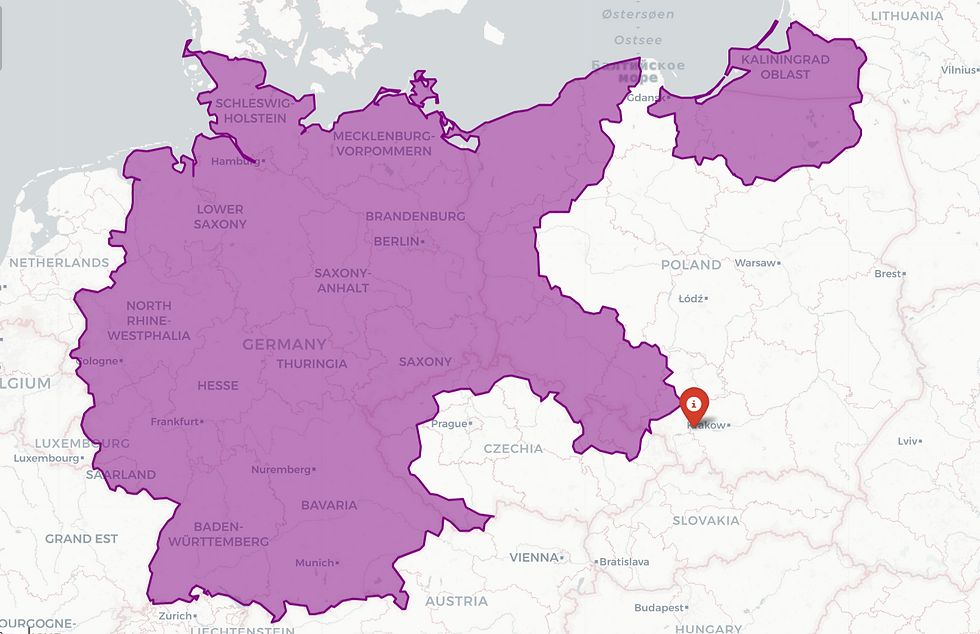
Although most of cases in Germany cooperated with Stalin were arrest of war criminals, seemingly, there were another type of massacre in Poland Area. According to the current history, Germany annexed Austria in 1938, so, Mauthausen could be also a Stalin type forced labor camp.
However, Auschwitz may have constructed by the Second Polish Republic and their investor League of Nations to exterminate liberals. The laws and constitution which were established after WWII clearly stated that there were war crimes like sending mass spies, murder, torture, etc. Perhaps, such crime may have happened mainly in the area occupied by League of Nations. Stalin constitution in Soviet fought against such war crime, so, it was on the opposite side.
Offshoot: Mystery of Marx
The war criminals resent "communists" and they continue to attack/ kill communists. In the current world, Karl Marx is regarded as a father of communism.
However, in the current history, he was born in Rhineland-Pfalz (the origin of the Pennsylvania Germans). Marx also did not participated in the 1848 German Revolution which stopped the construction of Ludwig Canal. Even he was arrested at that time, and then, he exiled to Paris and then London.
The famous phrase "religion is the opium of thought" may not have been said by this Marx because he exiled to London when China fought against UK due to the opium crisis (Opium war). The First Opium War happened from 1849-1842, and the Second Opium War happened from 1856 to 1860.
Rhineland-Pfalz was occupied by France after WWII (according to the official history). Perhaps, the history of Marx was falsified or the identity of real Marx was stolen during the occupation by anti-communists.
Comments