Botany/ Biology 2: Grasses versus Trees
- Bon Habler
- Jan 4
- 5 min read

Last time, I roughly explained the danger of anaerobes (who dislikes oxygen). The war criminals of WWII mostly weaponized anaerobic bacteria, or they themselves could be anaerobic human. So, one of the direct solution to exterminate anaerobes/ war criminals of WWII is "to increase oxygen" on the earth. For this reason to increase oxygen, I started to grow plants.
However, the world of plants are also diversified. There are pro-anaerobic plants (especially Rose family and trees). It is obvious that some plants are more aerobic and create more oxygen than others. In short, grasses (Poaceae or cereals) create more oxygen than other plants. Even within the world of vegetations, there wars between aerobic and anaerobic species.
One of the major conflict within the green world are "grasses versus trees". When I did not study botany so much, I roughly thought that any green was better than animal farming. But it is a very basic mistake. In fact, the shadows made by trees often kill grasses. And xylem (artery of plants to carry oxygen) is dead in trees during their secondary growth while grasses do not have such secondary growth. I will explain this issue in the following paragraphs.
Structure of Vascular Plants
Here is a rough category map of land plants. Within land plants, there are species with vascular system (similar to blood vessels of human body). They are called Vascular Plants or Tracheophytes (trachea is the windpipe which connects throat to lung in human body).

Vascular Plants are divided into several parts by the types of reproduction and structure. Aside from spermatophytes (seed plants), all plants mainly reproduce their children based on spores (asexual reproduction). As for seed plants, it is divided into two parts - gymnosperms (which does not cover the seeds, e.g. Conifer) and angiosperms ( which cover the seeds, e.g. Poaceae, Rosids, etc.). In angiosperms, there are also subcategories depending on the number of the leaves during their sprout. The two major subcategories are monocotyledon (Poaceae, etc.) whose seeds contain only one embryonic leaf and dicotyledon (Rosids - Rose family, etc.) with 2 leaves. Gymnosperm has 2 or more embryonic leaves. So, dicotyledon can be regarded as mixed blood with gymnosperm.
There are significant differences between monocots (monocotyledon) and dicots. For example, monocots have parallel "vein" while dicots have branched veins. In botany, all types of -vascular vessels are called "veins" unlike human. However, plants also have artery (to carry oxygen) and vein (to collect waste) in human blood vessels.

The next picture is about artery and vein in human body (legs). You can find that arteries (to carry oxygen) are relatively parallel while veins (to collect waste) are branched. So, I suspect that monocot leaves have artery while dicot leaves are mainly veins. Then, monocots are more aerobic.
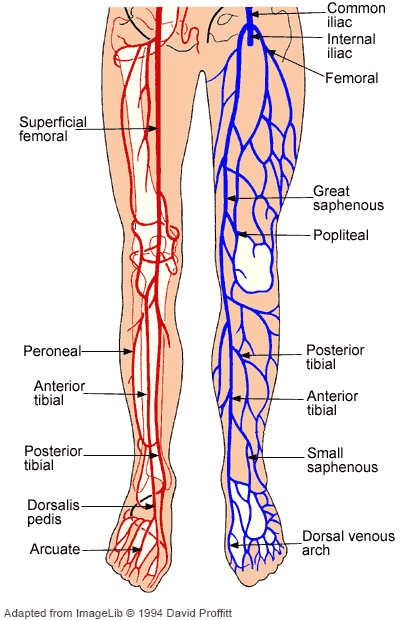
One more major difference is about their vascular system in the stems. Monocots have scattered vascular (and the number of vascular is much more than dicots) while dicots have ringed vascular. The next picture is the difference of the tissue of the stems of monocots and dicots. There are various kind of pictures about this issue. But this picture shows how monocots' Xylem (artery) is much bigger than that of dicots. In stem, Xylem has the function of artery (to carry oxygen) and Phloem is similar to vein.

Secondary Growth - Death of Xylem
Another major difference between monocots and dicots (+gymnosperm) is the secondary growth. Dicots and gymnosperm have secondary growth which makes their stem woody while monocots do not have it. During the secondary growth, Xylem (artery) dies in their stem and their stem become hard woody texture.
Secondary growth occurs in gymnosperms and most dicotyledons. Annual plants (e.g., most crop plants) do not have secondary growth. Perennials (e.g., trees) have secondary growth. Secondary growth is a type of growth characterized by an increase in the thickness of the stem and the root, and it results from the formation of secondary vascular tissue by the vascular cambium. The cambium is a meristem. A meristem is undifferentiated plant tissue, which is involved with formation of new cells by division. New growth begins in a meristem. If secondary growth takes place, a vascular cambium occurs between the xylem and the phloem. It produces secondary phloem toward the outside of the plant and secondary xylem toward the inside of the plant. Wood is the secondary xylem of gymnosperms and dicotyledons. Bark is secondary phloem.
Another description is here. It articulates that xylem. The tissue of the secondary xylem is also called "Sclerenchyma" (dead tissue) while the first xylem tissue is called Collenchyma (living ragged tissue). After plants experienced the secondary growth, it acquired the ability to make oil, tannins and resins which often causes diseases to animals, used as weapons etc..
The secondary xylem differentiates from the vascular cambium toward the interior of the stem. The secondary xylem of angiosperms is composed of traqueae, tracheids, sclerenchyma fibers, and parenchyma cells. The new xylem, closer to the meristem, contains living cells that conduct substances. The inner part of the secondary xylem is dead tissue and does not conduct anything. As the secondary xylem layers get older, parenchyma cells die, and the chemical composition of the cell walls of the xylem cells changes; that is, the wood is modified. Storing substances are removed, and cells are infiltrated with oils, tannins, or resins.
The followings are the tissues of parenchyma, collenchyma, and sclerenchyma (ref: Ground Tissue). After the secondary growth, collenchyma and parenchyma tissue dies and replaced by sclerenchyma. You can find that sclerenchyma lost nucleus, and the pits of cell wall is closed (it means they shut down oxygen).

Secondary Growth of Human? - Muscle and Fat
In fact, human also has similar effects of the secondary growth and related tissues. Parenchyma/ Collenchyma are close to brown fat cell (made by sugar) while sclerenchyma is close to muscle. Brown fat is mainly made by sugar (glucose) which is rapidly used to heat body when it is needed. But white fat is made by oil. Bile changes white fat into beige fat by adding mitochondria.


As for muscle tissue, there are 3 types of muscles. However, muscles in the bodies of athletes are mainly "Skeletal muscle" whose fiber is the most similar to sclerenchyma. Skeletal muscle also relies on anaerobic respiration. Although several websites say that skeletal muscle has the most nucleus, the following picture shows skeletal muscle does not have black/dark purple points compared to smooth muscle and cardiac muscle.

Poaceae (monocots) as Pioneer Species
In any case, it has become clear that Poaceae (grains or grasses) species are more aerobic than dicots and gymnosperm because they have strong and living xylem and artery like veins in leaves.
Poaceae is also regarded as one of the "Pioneer species" which come back to devastated land and recover the soil. Such pioneer species often grow very rapidly, spread by asexual reproduction, autotroph (organisms which can create their or nutrition from inorganic materials), have strong ability of photosynthesis with strong preference of sunlight, and fix carbon (nutrition for other heterotroph = non-autotroph).
The richness of soil is determined by the percentage of carbon. Many heterotroph can grow in the carbon rich soils. Pioneer species uses CO2 to make carbon, and CO2 is the only one available resource of carbon for autotroph. They make glucose (sugar) from CO2. So, the recent anti-CO2 campaign was funded by anaerobic group (or the species which were damaged by the Permian extinction).
Only after grasses/ Poaceae recovered the soil, dicots and trees come to the land. The tall trees make shadow and kill grasses. The environment becomes anaerobic and anti-sunlight (sciaphilous). In the end, the place becomes dark and anaerobic environment which is full of dangerous bacteria and plants which cause diseases to human.
So, planting grasses is one of the concrete way to increase oxygen, recover the land and fight against anaerobic terrorist group.

Comments