Historical Map of Israel and Oslo Accords
- Bon Habler
- Oct 25, 2025
- 8 min read

Recently, Trump regime forced Israel to accept the peace (?) deal in Gaza. Most far-right Israeli politicians got angry about it because it obliterated the Israeli military operation for these 2 years. As well as other places, Trump always seeks for his own profit rather than making peace...
Historical Border Change of Israel
In any case, let's check historical map of Israel.
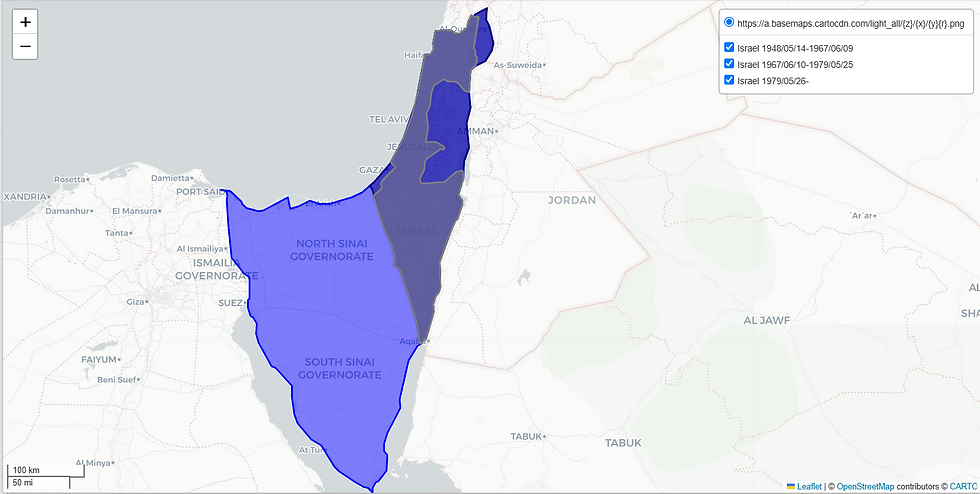
(You can download the dynamic map in this zip file.)
In 1948, Israel became an independent state (independence from the British mandate Palestine), and the country of Israel emerged. In 1967, Israel expanded its realm to Sinai, Gaza, West Bank, and Golan heights. At that time, both of Israel and Egypt fought against UNEF (United Nation Emergency Forces) and UNEF I was dissolved. However, it lost Sinai in 1979 by UNEF II.
1967 Withdrawal of UNEF and Israeli Expansion to Sinai
UNEF was originally established to solve Suez crisis in 1956. The detail of Suez crisis and original conflict are unclear due to the falsification of history. But seemingly, it was the first UN peacekeeping force. The website says UNEF aimed to facilitate the withdrawal of the military of UK, France and Israel. However, I am not sure if such countries were not ally of UN or not.
In any case, the second and the last commanders of UNEF were Indians. Since WWI, Indians sustained the British mandate military as a major source of soldiers.
Nov. 1956 – Dec. 1959 Lieutenant-General E. L. M. Burns (Canada) Dec. 1959 – Jan. 1964 Lieutenant-General P. S. Gyani (India) Jan. 1964 – Aug. 1964 Major-General Carlos F. Paiva Chaves (Brazil) Aug. 1964 – Jan. 1965 Colonel Lazar Mušicki (Yugoslavia) (Acting) Jan. 1965 – Jan. 1966 Major-General Syseno Sarmento (Brazil) Jan. 1966 – June 1967 Major-General Indar Jit Rikhye (India)
As for the second commander P.S. Gyani, the information is very limited. But seemingly, he finished his military education in UK, and fought in Burma in 1942-1945 as a British soldier. After that, he became a commander of UNFICYP (UN peacekeeping in Cyprus). His surname seems a Punjabi origin Sikh. Punjab was divided into two part after the independence war in Pakistan and India. Sikhs mostly moved from Pakistan to Indian part of Punjab after 1947.
The last commander Indar Jit Rikhye was also born in Punjab (Pakistan part) but moved to India after 1947. He fought in Jammu Kashmir in 1947 as a part of Indian military. However, he changed his career to the UN peacekeeping in the 1950s. He fought in Gaza as a part of UNEF in 1950s, and he was assigned to the UN peacekeeping mission in Congo in 1960s. The Congo peacekeeping mission was established by the Ethiopian emperor to destroy the real independence of Congo from Belgium. It hired "Kennedy refugees" who arrived in the South/ East African countries by sea route.
In 1967 when UNEF withdrew from Egypt, the commander was Rikhye. Egypt ordered UNEF to withdraw from Sinai. On the other hand, Israel also attacked UNEF and many Indian soldiers with "Singh" surname (the surname came from Sikh community) died. So, it seems that both of Egypt and Israeli army fought against UNEF (UN peacekeeping force).
In the end, UNEF was dissolved and Israel expanded its realm to Sinai. It is unclear why Israel expanded but not Egypt. After that, Rikhye resented Israel due to this incident and established International Peace Institute in 1970. He published a book whose title was "The Sinai Blunder" in 1978. And this International Peace Institute is the organization which led Oslo Accords in 1993, which led Arafat and Shimon Peres to receive the Nobel Peace Prize. This Accords aim at withdrawal of Israel from the realm of Palestine and it is the origin of the movement which intends to establish the state of Palestine.
International Peace Institute
Rikhye established International Peace Institute in 1970. It is said that it had an office in Austria too, until 2020. Since UN related organization and wikipedia often tell lies, I checked the official commercial registration in NY (their alleged main office is in NY). This organization's past name was International Peace Academy. So, it is likely to be the one which conducted the Oslo Accords in 1993. Although wikipedia and IPI official webpage said their organization started in 1970, the registration in NY is in 1989, and their formation of foreign office was in 1950 according to the NY business registration. Also, NPO/ NGO is one form of "company" although they declare themselves as "non profit". When I studied land and company registration laws in my home country, NGO/ NPO were also a subsection of "company" as well as Foundation.
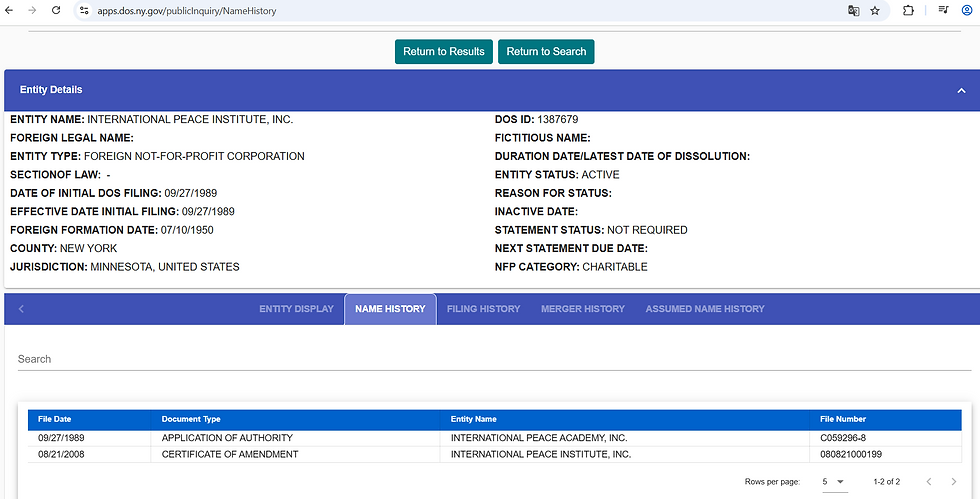
In any case, according to the official webpage of IPI, the chair of the board directors is Jean Todt, the former president of FIA (International Federation of Automobile) - car industry. It is said that IPI also contributed to establish ICC (International Criminal Court), and the judges/ committee of ICC also had a strong link with car industry such as Toyota. So, the Oslo Accords could have been also funded by car industry terrorists. In fact, Israeli media often reports Toyota cars as cars of terrorists.
Jean Todt Chair UN Special Envoy for Road Safety Former President of Fédération Internationale de l’Automobile (FIA)
The recent peace deal meeting in Gaza by Trump regime was held in Sharm el Sheik. And this is the last place where UNEF withdrew from Egypt in 1967. So, the recent Gaza peace deal was also led by the past UNEF faction (= Oslo Accords).
UNEF II and Employment of Refugees
After the withdrawal of UNEF in 1967, Rikhye established International Peace Institute (according to their official website) in 1970. UN took a vengeance after the Yom Kippur war, and established UNEF II in 1973.
Remember that 1973 was the year when the 10 million Indian "returned refugees" suddenly disappeared. So, assumingly, a part of this "Indian returned refugees" went to Afghanistan and Pakistan to conduct coups there (1973 Daoud Coup in Afghanistan and 1972 Constitutional Coup to remove army government in Pakistan) and other refugees were absorbed in UNEF II. In addition, a party of this refugees became likely to move to Lebanon at least around 1971. The Japanese Red Army (Leninist army) was established in 1971, and its headquarter was in Beqaa, Lebanon. In the statistical sense, these groups were counted as "destination: unknown" until 1976

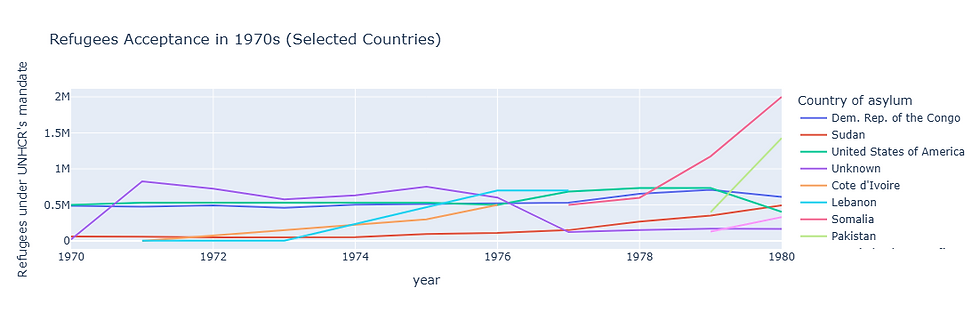
In 1971, suddenly the destination: unknown refugees became the top of the list (828000). However, this is a number of the "Refugees under UNHCR's mandate" in this data. The exceptional number of mysterious refugees in 1971 and 1972 appeared in the category of "Returned Refugees" (origin: India).

The destination unknown refugees kept on the top until 1975. In 1976, Lebanon suddenly became the top country which accepted 700k refugees (almost the same number as the "destination unknown refugees" until 1975). In 1977, Lebanon stayed in the top, and the number of destination unknown refugees dramatically dropped. In 1978, the refugees in Lebanon suddenly disappeared. And 1978 is the year of the establishment of UNIFIL (UN Peacekeeping in Lebanon). So, just like the case of Congo, maybe UNIFIL hired lots of UNHCR refugees. After the unknown refugees decreased in the end of 1970s, Somalia and Iran, Pakistan suddenly increased the refugee acceptance.
Since 1973 (the establishment of UNEF II), UNDOF (Syria Golan Heights) was established in 1973. Maybe, UN spies penetrated to Lebanon from Golan Heights. Then, UNIFIL (Lebanon) was also established in 1978. UNFICYP (Cyprus) became active since 1974. So, they enclosed Israel at least by four UN peacekeeping forced which hired the Kennedy refugees (10 million Indian returned refugees) in 1970s.
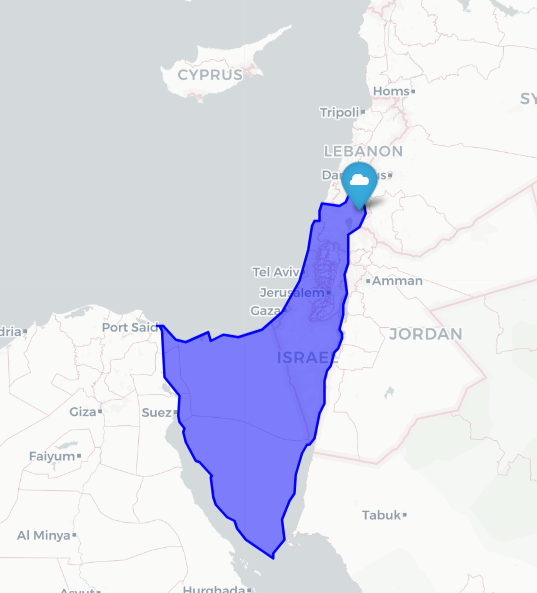
In the end, Israel withdrew from Sinai in 1979. After the mission of UNEF II was completed, it was dissolved. However, they still resent the case of Palestine and Golan Heights. So, their missions are still active as well as Cyprus and Lebanon.
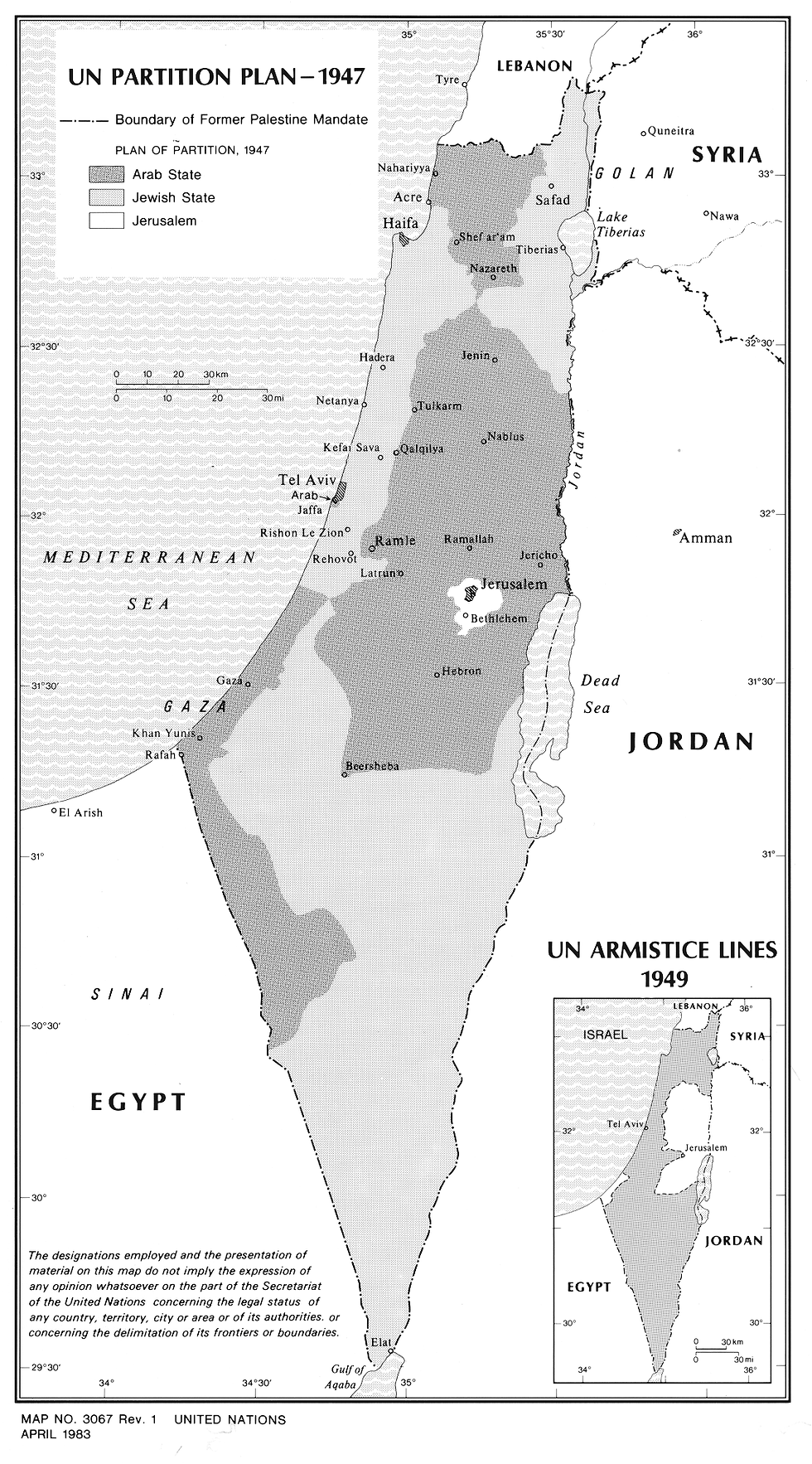
*It is also said that UNTSO is the origin of the all anti-Israel UN peacekeeping mission. This force was established to maintain the Israel/ Palestine border of the 1947 UN partition plan. It is noted that the Arab State (Palestine) includes Tel-Aviv, Haifa and Acre. It is very similar to the districts in favor of the Labor party of Israel. Honestly, UNTSO seems just a successor of British Mandate Palestine military.
Oslo Accords in 1993
In any case, UN peacekeeping continued to fight against Israel in 1970s and 1980s. In 1993, Oslo Accords were signed by Arafat and Rabin (Labor party of Israel) brokered by Clinton. Seemingly, the International Peace Institute established by Rikhye (the last commander of UNEF) led this accords. So, Oslo Accords were an vengeance against 1967 Israel by UNEF.
This accords became the origin of the "Two State Solution" (to make Palestine as a state), and their attempt still continues. The recent peace deal in Gaza by Trump regime was obviously on the line of UNEF/ Rikhye/ UNTSO = British Mandate Royal military.
Indians in British Royal Military
As I researched about UN peacekeeping forces against Israel, I noticed that such forces hired lots of Indians. In fact, India was the largest human resource for the British Mandate alliance during WWI/ II. For example, the battle of Gallipoli against Ottoman and the battle in Egypt (Coptic church) were also sustained by Indian soldiers. Such Indian soldiers were also sent to East Africa to fight against Prussia Germany (German East Africa) and Italian Somaliland. Gandhi and Rishi Sunak (the past British PM whose ancestry moved India to Tanzania and Kenya and then, UK) were also in the same line (Indian British colonial soldiers who moved to East Africa).
Many of them were originally born in Punjab of Pakistan, and they had to move to India in 1947 because Pakistan became an Islam country. Most of people who moved from Pakistani Punjab to India were "Sikhs" because Lahore (Punjab) was a capital of Sikh Kingdom. So, naturally many of them (including the two Indian commanders of UNEF) fought against Pakistan in Kashmir (1947) and in 1960s.
Sikh Kingdom and Its Revolt against Mughal Empire
In the 18th century, Sikhs led a raid against Mughal Empire (Indian Islam empire) and West Afghanistan, and established Sikh Kingdom. Since 19th century, their capital was in Lahore (the birthplace of Imran Khan). And this Sikh empire was governed by the people with the surname of "Singh" (the UNEF soldiers who were killed by Israel mostly had this surname). Also, India had only one Sikh Prime Minister, Manmohan Singh (2004-2014). He was the person who cooperated with Karzai of Afghanistan to reconstruct Habibia High School in Kabul (the school educated most of the Afghan globalist politicians including Ghani and Karzai). So, Sikhs in India and Pashtuns are alliance, or even, "Afghanistan UNHCR refugees" include Sikhs. Manmohan Singh was also born in the current Pakistan part of Punjab in 1937, but moved to India (Uttarakhand - adjacent to Tibet) after the partition of Punjab.
In another word, this Sikh Revolt against Mughal Empire was one of the earliest examples of "Arab Revolt" (1916-18) type resistance against Islam empire. Arab Revolt was the independence movement caused by Hashemite (the current royal family of Jordan, and the past Iraqi and Syrian royal family). And perhaps, Sikhs spread anti-Islam independence movement to the middle east. I suspect that the current Qatari Emir who led the recent Gaza ceasefire (Sheik Tamim bin Hamad Al Thani) is linked to Sikh because his title "Sheikh" (as well as the place of the recent ceasefire - Sharm El Sheikh) is written as شيخ. (Shykh). In Arabic, they do not write vowels so much aside from y. The spelling is not Sh-e-y-kh but sh-y-kh. On the other hand, Sikh is سيخ (S-y-kh). These are almost the same.
Such people became the core of Christian "Arabs" who try to establish Palestine as a state. So, it is very understandable that Gulf countries accepted lots of Pashtun refugees. Maybe Sikhs educated such Arabs to fight against Ottomans.


Comments