Refugees in Iran, Afghanistan, and Pakistan
- Bon Habler
- Feb 3, 2025
- 7 min read

Pakistani Diaspora and JICA's Invasion
In the last article, I got to know that the "refugees" (defined by UNHCR) are mostly descendants of the war criminals of WWII or workers of the WWII war criminals organizations. Also, in the first few articles, I analyzed Pakistani diaspora as the key point to understand the terrorism crisis, at least since ISIS era or 911.
Seemingly, Pakistan (especially Peshawar) has been functioned as a spy hub against Soviet since 1960. At that time, JICA (Japanese war criminals) built the Mangla Dam in 1954 and Japanese Christian Aid started to work in Afghanistan since 1960. The medical volunteer NGO contained survivors of Hiroshima Atomic bomb, so it was also a part of war criminal group. Since then, Pakistan was colonized via the flood terrorism caused by Mangla Dam. This method was already used in Egypt via Aswan Dam, and Egyptian military government fought against Aswan Dam in 1960s and 1970s.
Such fake development projects push the vast amount of debt to the country, and construct a part of infrastructure of the country. However, the seizure of infrastructure by foreigners is harmful for the independence of the country especially if the constructors/ development projects are full of war criminals of WWII or foreign invaders. Such invaders often conceal their real purpose (invasion), and they call it as "dual use" (civil infrastructure use and terrorism use). This is nothing but a development fraud. Seemingly, this method was also used during WWII, and the real figure of the war and attacks were natural (?) disasters caused by such terrorists. As far as I know, they cause floods by dam, earthquakes by a certain method of metallurgy (melting of metal by high temperature), building collapses by metallurgy, volcano eruptions by metallurgy, typhoon and hurricane etc. I have not known the concrete methods about it. However, until 1970s newspapers dealt with the topic of earthquake as a defense issue or a military attack.
It is noted that most disaster terrorism is based on metallurgy because the earth's inner core and crust contain metals. In Turkey, there was a big earthquake in 2023. And civil engineers said that there was a flood of "boiled water" from underground right after the earthquake in Hatay. The death numbers were increased a lot after Red Cross arrived in the earthquake zone, and British Royal Military established the field hospitals (*Field hospitals are established mostly in war time).
In any case, Pakistan and Iran accepted a large amount of Afghanistan refugees when Afghanistan experienced the communist revolution in 1978. They are counted as "refugees" by UNHCR, so, it is likely that the refugees contained the war criminals of WWII and its successors. It strengthened the function of Pakistan as the hub of anti-communists, obviously. The map blow is about the countries which accepted refugees in 1988 when Soviet and Berlin were about to be collapsed. It is obvious that such anti-communists/ war criminals of WWII were intensively deployed in Pakistan and Iran.
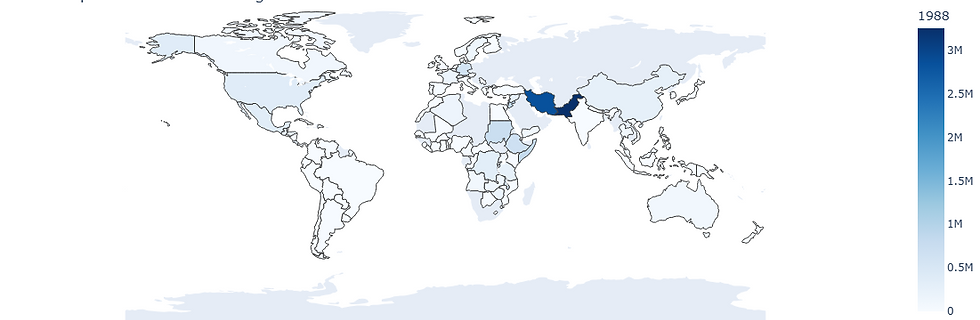
This table is about the top 10 countries which accepted refugees in 1988, and the accepted refugee numbers in each country in 1988.
Country Name | 1988 |
Pakistan | 3257577.0 |
Iran, Islamic Rep. | 2850000.0 |
Jordan | 884040.0 |
West Bank and Gaza | 856639.0 |
Somalia | 834000.0 |
Sudan | 745000.0 |
Ethiopia | 679532.0 |
Malawi | 628133.0 |
Germany | 610200.0 |
United States | 377769.0 |
Let's check the details of data about the refugees in the West Asia.
Refugee Dynamics in South Asia
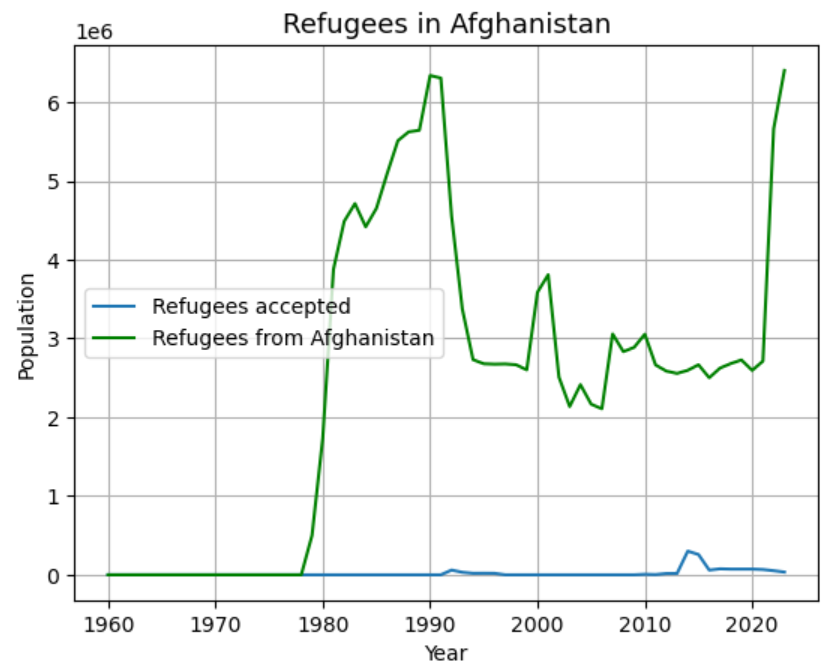
First graph is about the Refugees in Afghanistan, the green line indicates refugees from Afghanistan (their origin is Afghanistan). In Afghanistan, Saur Revolution happened in April in 1978, and Democratic Republic of Afghanistan was founded. Obviously, there is a leap of refugees from Afghanistan since then. It reached to the peak with more than 6000000 refugees around 1990-1991 (the fall of Soviet). After that, the refugees gradually went back to Afghanistan. However, the refugee numbers saw a dramatical increase in 2021 when "Taliban" regained the power. I suspect that the "Taliban" government since 2021 contains the past communist Afghan officials.
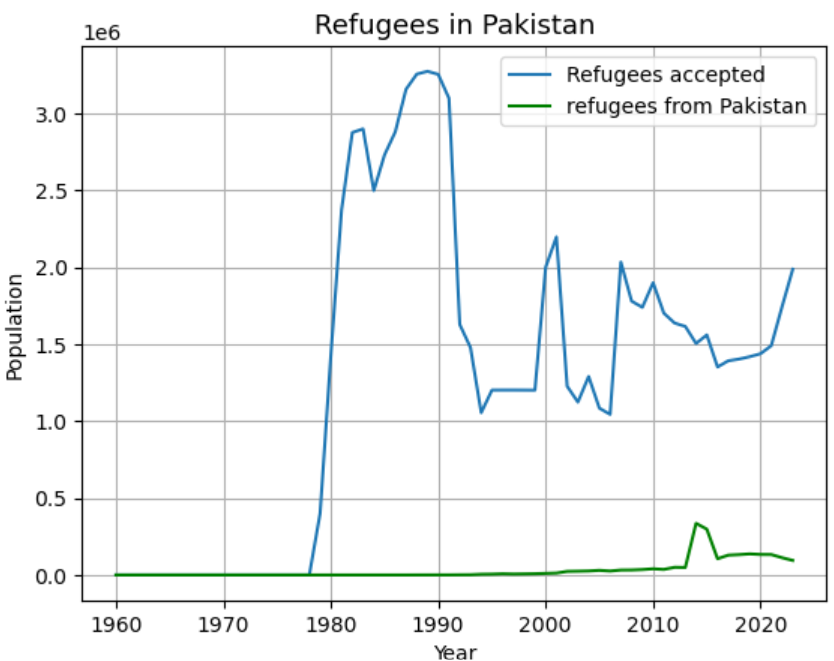
The next graph is about Pakistan. The shape of the graph is similar to that of Afghanistan, however, the blur line is the acceptance of refugees. Assumingly, many Afghan refugees (anti-communists) moved to Pakistan. In the peak time around 1989- 1990, it amounted to more than 3500000. So, almost the half of Afghanistan anti-communist refugees may have arrived in Pakistan since 1978. Another possible neighbor which accepted Afghan refugees is Iran.
This is the graph about refugees in Iran. Possibly, they accepted the rest half part of Afghan refugees until 1989. However, the number of refugee acceptance around 1990-1991 surpassed 4500000. So, it is likely that Iran accepted refugees from other countries around 1990.

Mystery of Refugee Trend in Iran
One mystery of the data of Iran is that they accepted anti-communist Afghan refugees although they experienced Iran Revolution in 1979, which ousted monarchists. Also, normally, pro-British monarchy regime prefers to accept foreign immigrants and refugees. However, there were almost no refugees until 1978 (compared to the post -Afghan refugees).
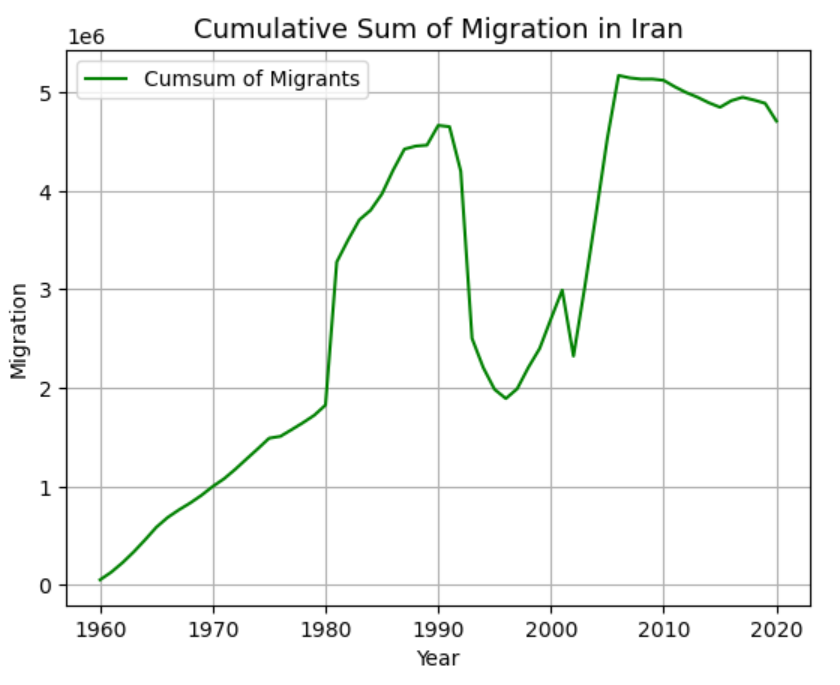
Here is the net migrant numbers in Iran by year. Seemingly, there were almost no migrants until the Afghanistan revolution. Iran accepted Afghanistan immigrants largely in 1981, and such people moved out around 1991- 1992. **There is a big difference between migrants, immigrants, emigrants, and refugees. Immigrants include the "accepted refugees", however, not all immigrants are refugees. As I stated above, the "refugee" status is exceptionally applicable for the people who are related to the war criminals of WWII, and cooperated with the anti-communists' invasion. Also, emigrants (who left the country, for example Iran in this case) contains the refugees whose origin is the country (e.g. Iran in this case). But not all emigrants are counted as refugees by UNHCR.

The next graph is about the cumulative sum of migrants in Iran. Compared to the graph about refugees, you can find that there is no sharp increase of migrants around 1989-1991. Perhaps, the refugee leap around 1989-1991 contained the past Iranian monarchists. In the national statistics, returned diaspora is not counted as "immigrants", if they did not lose their nationality.
In fact, Iran experienced a political change since 1989 by Akbar Hashemi Rafsanjani - Wikipedia and Mohammad Khatami - Wikipedia. They propelled neoliberal policy such as privatization of governmental organizations. The modern Iran has two conflicted major political factions - Principlists and Reformists.
Since 1989, Reformists such as Hashemi and Khatami seized the power in Iran until 2005. The surname Hashemi is similar to Hashemite, the royal family's surname in Jordan (Palestine refugees) and other Arab Revolt (against Ottoman) faction. Interestingly, such reformists of Iran even welcomed the US invasion against Afghanistan in 2001. So, this reformist faction is Iran is pro-CENTOM (anti-communists). It is clear that reformist's regime mostly accepted refugees. After the death of Raisi (principlist), Iran became under reformists again.
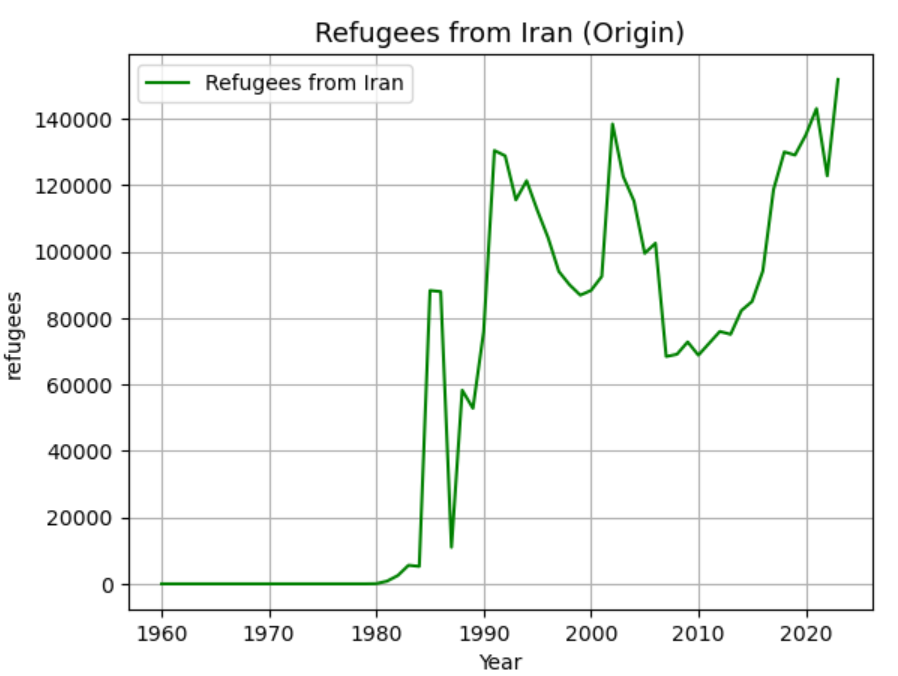
Also, there was a mysterious drop of Iranian origin refugees around 1987. Also, perhaps, the history of Iran was somehow falsified. The big wave of refugees appeared around 1983, rather than 1978. I am not sure, but was the Iranian revolution in 1978 really against "monarchists"? Was there no communist regime in Iran in the post-war process? Also, why Afghanistan communist/ conservative government still choose Persian to speak? As far as I know, communist government tend to keep migrant numbers at very low, just like Iran until 1980 or 2005 - 2020 (Principlist era).
This is my assumption, but perhaps, the 1979 Iranian revolution was caused by the reformist side or Hellenist. Then, the Afghanistan refugees (anti-communists) may have cooperated with the Iranian revolution in 1979. However, Iranian domestic war between Principlists and Reformists kept the balance not to go extreme (extreme Leninists). In such case, the "monarchist refugees" may have appeared after the WWII (not in 1979). It is possible because there was a big gap between the two data from UNHCR (origin based refugee data and recipient country based data). There were about 2500000 refugees without data of their origin. So, the Iranian monarchists could be a part of them (war criminals of WWII who were purged from their countries).
the refugee acceptance numbers in 1960 is much bigger than the refugee numbers in the data based on their origin. I mean that in the first table, only Angola (as the origin of the refugees) has refugees (150000), however, the following table shows other kind of refugees which amount to 2641151. So, there is a obvious gap (about 2500000). In 1960, positive numbers were found only in 23 countries (until Tunisia in the table below). Assumingly, these people are the war criminals of WWII who were purged by the post war liberals. - Refugee Data and Emigrant Crisis in 1964
Pakistani Diaspora and Refugees in Pakistan
As for Pakistani diaspora/ refugees, it is revealed that most of the Pakistani diaspora (more than 20 million since 2010) was not counted as refugees by UNHCR. There was a slight jump of refugee numbers (Pakistan origin) around 2014 when Ghani became the president. The amount is about 300000. And you can find almost the same accepted refugees in the graph of Afghanistan. So, these 300000 "refugees" are the people who cooperated with Ghani to kill Afghanistan Taliban (Ghani killed more than 120000 afghans by cooperating with CENTCOM and such Pakistani "refugees" in 4 years). And the incident in 2014 was an exception of Pakistani immigrants in Afghanistan. Aside from the Ghani's era, Pakistani did not move to Afghanistan so much.
These 300000 Pakistani refugees were treated as special cases, and they were helped by UNHCR to move to Afghanistan. I am not sure if these 300000 Pakistani "refugees" were really originally from Pakistan or mixed blood with invaders (war criminals of WWII) or identity theft of dead Pakistani (killed by floods?) or some. However, what happened on other 20 million (minus 300k) Pakistani diaspora? Perhaps, such Pakistani diaspora was trapped by illegal migrant brokers and they were forced to cooperate with terrorist organizations, or killed by such illegal brokers and stolen the identity by them.
In any case, 20 million is much bigger than the population of the biggest city like Tokyo and Istanbul. Such level of population suddenly disappeared from Pakistan just in 10 years! This is surely a big problem but UNHCR does not deal with it as a "refugee" case.
So, assumingly, these "Afghanistan refugees" strengthened the anti-communism in Pakistan and Iran as after they moved to such countries. But who were such Afghanistan refugees? Where were their real origin? - This is the question for the next article.


Comments